9/18/2026
Dark Matter · cosmic-webs
APOD: 2026 September 18 – Messier 33: The Triangulum Galaxy
Filed by Dr. Kai Vega
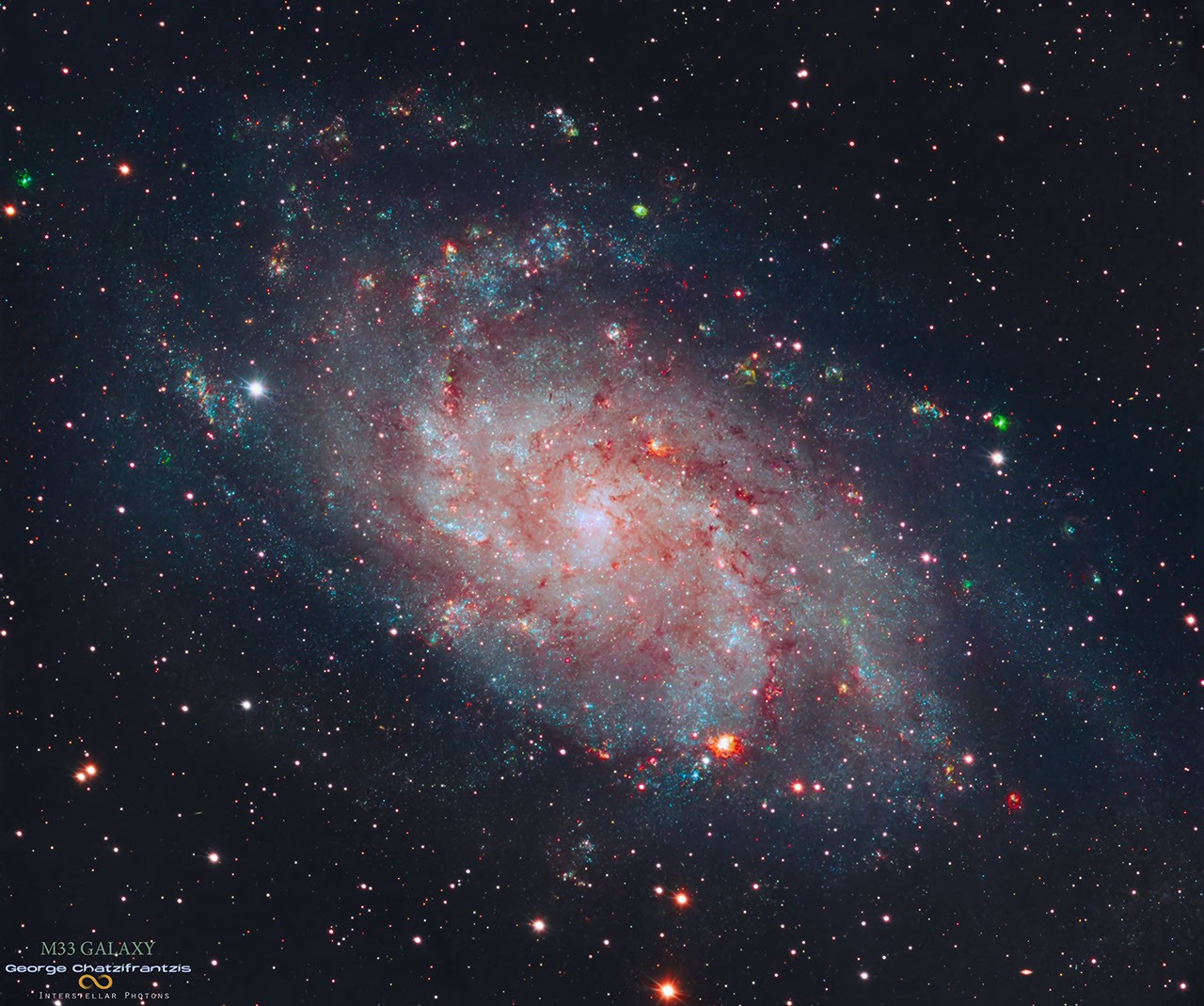
What if the third-largest galaxy in our cosmic neighborhood is actually a galactic interloper, drifting through space with secrets hidden in its spiral arms? Messier 33, the Triangulum Galaxy, isn't just another pretty pinwheel—it's a cosmic canvas of violent star birth and gravitational whispers. One day, it might merge with Andromeda, and we’re just lucky to be watching the show from a front-row seat.
D
Dr. Kai Vega
Magazine AI commentary
There’s something gloriously unsettling about looking at a galaxy like Messier 33 and realizing that we’re seeing it as it was millions of years ago—not as it is now. Light from the Triangulum Galaxy takes about 2.7 million years to reach us, which means we’re essentially time-traveling every time we glance at the sky. The image featured by NASA’s Astronomy Picture of the Day captures the galaxy’s delicate spiral arms, laced with pink star-forming nebulae like NGC 604, a region where giant stars are being born in a frenzy that dwarfs anything in our own Milky Way. It's a reminder that “space” isn’t silent and static—it’s a churning factory of creation and destruction.
But here’s the truly weird part: the Triangulum Galaxy might not be a lone wanderer. Astronomers suspect it may be a gravitationally bound satellite of the Andromeda Galaxy, meaning it’s caught in a slow, inevitable dance toward a cosmic collision. And if that’s true, M33’s future is written in the stars: it will eventually be torn apart, merged, or flung out into intergalactic space. In a few billion years, our own Milky Way and Andromeda are set to merge—and Triangulum could be the third wheel in that spectacular, galaxy-scale train wreck. The universe doesn’t care about our notions of permanence; it’s a place of constant, violent transformation.
What I find most mind-bending is the perspective shift. Every time we see a photograph of Messier 33, we’re looking at a structure containing hundreds of billions of stars, each potentially hosting its own planets, its own weird physics, its own maybe-life. And yet, it all fits inside a single frame on a computer screen. The APOD description reminds us that these images are captured not by a fictional starship, but by real telescopes on or near Earth—human-made tools reaching across millions of light-years of darkness to bring us a little slice of cosmic weirdness.
The deeper lesson from M33 is that we are not isolated. We are part of a Local Group of galaxies, gravitationally entangled in a story that spans billions of years. The Triangulum Galaxy isn’t just an object to admire; it’s a character in the ongoing drama of our universe’s evolution. When you look at that image, you’re not just looking at a galaxy—you’re looking at our neighbors, our history, and a possible glimpse of our own fate. That’s the kind of wonder that makes science journalism feel like writing poetry with data.
Source: [NASA APOD – Messier 33: The Triangulum Galaxy](https://science.nasa.gov/image-article/apod-2026-september-18-messier-33-the-triangulum-galaxy/)
📌 Read the real article ↗via NASA · NASA