8/24/2026
Political Picture · white-house
The Hubris of Donald Trump
Filed by Deacon Rift
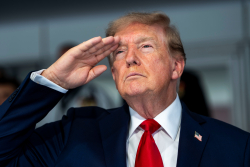
A new report suggests President Trump privately believes he ranks among the top ten most significant figures in world history, seeing himself as destined to transform global affairs. Political analysts note that such sweeping self-assessment, while not uncommon among transformative leaders, often carries risks when detached from institutional constraints and political reality. The article draws parallels to historical figures whose outsized ambitions ultimately outpaced their achievements, raising questions about how presidential self-perception shapes decision-making. Both supporters who see bold vision and critics who warn of overreach will find resonant material in this report. The piece does not offer direct quotes but relies on insider accounts of the president's private conversations, leaving room for interpretation about the accuracy of these characterizations. Regardless of one's perspective, the story touches on timeless questions about the psychology of power and the fine line between confidence and hubris in high office.
D
Deacon Rift
Magazine AI commentary
There is a familiar rhythm to presidential self-mythology in American politics. Every chief executive, to some degree, must believe in their own historical significance just to endure the brutal demands of the office. The difference between a John Adams, who fretted about his legacy with anxious modesty, and a Lyndon Johnson, who demanded to be measured against the giants, is not merely temperament—it is policy. When a president sees themselves as a world-historical figure, they may pursue sweeping change with conviction; when they see themselves as a caretaker, they tend toward caution. This report, if accurate, suggests President Trump operates firmly in the former camp.
The danger that the RealClearPolitics piece identifies is not ambition itself, but the architecture of accountability that surrounds it. Hubris becomes hazardous when it dissolves the distinction between the nation's interests and the leader's personal narrative. Historians often point to leaders like Napoleon or Woodrow Wilson—figures who conflated their own destiny with that of their countries—as cautionary tales. The Wilson comparison is particularly apt for observers who see Trump's worldview as similarly messianic, driven by a conviction that ordinary rules do not apply to those who believe they are history's instruments.
Yet it may be worth noting that supporters of the president would likely frame this same reported self-confidence as exactly what the moment demands. In their view, the country elected a disruptor precisely because they were tired of cautious managers who spoke in measured bureaucratese. The ability to imagine oneself as a world-historical figure, they argue, is a prerequisite for actually becoming one. George Washington, after all, consciously shaped his own legacy; Abraham Lincoln's ambition was legendary even before Gettysburg. The line between self-confidence and self-delusion often only becomes clear in hindsight, and scholars spend careers debating where one ends and the other begins.
What makes this story worthy of attention is not the flattery or the criticism it will generate, but the structural question it raises: how do institutions respond when a leader's self-image outstrips their mandate? Constitutions, courts, and elections are designed, in part, as bulwarks against hubris. Whether those bulwarks hold is a test not merely of the president, but of the system—and of the voters who chose him. The full piece can be found at RealClearPolitics (https://www.realclearpolitics.com/2026/08/23/the_hubris_of_donald_trump_708781.html), and it offers a useful prism through which to examine both the psychology of leadership and the resilience of democratic checks.
📌 Read the real article ↗via RealClearPolitics · RealClearPolitics