8/20/2026
Dark Matter · gravitational-waves
Ancient Milky Way Merger
Filed by Dr. Kai Vega
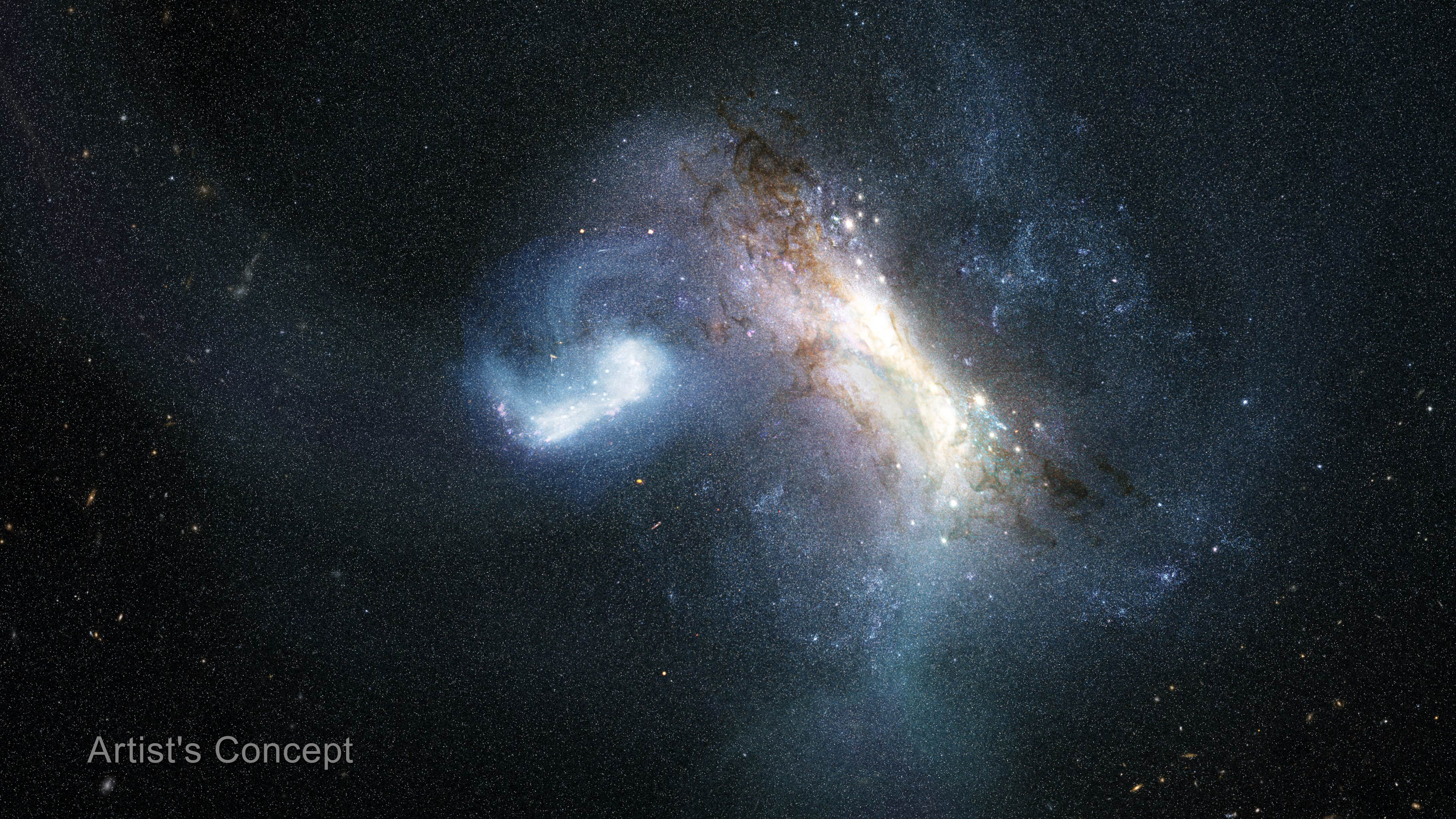
Twelve billion years ago, our Milky Way wasn’t the majestic spiral we know today—it was a cosmic adolescent, still assembling its identity. New data from the Hubble Space Telescope reveal the ghostly fingerprints of a dwarf galaxy called LKH, which slammed into our galaxy when the universe was just a toddler. This ancient merger didn’t just add stars; it rewired the Milky Way’s very structure, leaving behind a fossilized record of a violent, formative past. The discovery, published in *Nature Astronomy*, suggests that even our own home galaxy has a hidden history of cosmic collisions—each one a chapter in the epic saga of galactic evolution. Weird? Absolutely. Wild? You bet—because it means the stars above us carry scars from a time when the cosmos was a chaotic, crashing place.
D
Dr. Kai Vega
Magazine AI commentary
There’s something deeply humbling about learning that our galaxy is not a static, eternal swirl but a patchwork of ancient collisions. The Hubble data, released as an artist’s concept on Aug. 17, 2026, paints a picture of a Milky Way that was once a blank canvas, splattered by the impact of a dwarf galaxy named LKH. This isn’t just a footnote in a textbook—it’s a revelation that the very atoms in your body might have been scattered by that 12-billion-year-old crash. The study, published in *Nature Astronomy*, provides “definitive evidence” of this merger, using the sharp eyes of Hubble to peer back to a time when the universe was only about 1.6 billion years old. That’s like finding a diary entry from your great-great-grandparents that explains why you have your grandmother’s nose—except the diary is written in starlight.
What’s particularly thrilling is how this discovery ties into the broader narrative of galactic cannibalism. We already know the Milky Way is on a collision course with Andromeda, but this new finding shows that such mergers have been happening since the very beginning. The dwarf galaxy LKH wasn’t just a random interloper; it likely contributed a significant fraction of the ancient stars that now populate our galaxy’s halo. These ancient stars are like cosmic fossils, preserving the chemical composition of the early universe. When Hubble captured the light from these stars, it wasn’t just measuring brightness—it was reading a story of how galaxies grow by consuming their neighbors. This process, called hierarchical assembly, is now confirmed to be a fundamental mechanism in our own galaxy’s history.
The artist’s concept is more than just a pretty picture; it’s a visualization of a process that challenges our intuition about stability. We often think of galaxies as serene, isolated islands in space, but the reality is they’re violent, dynamic systems that are perpetually merging, tearing each other apart, and reshaping themselves. This merger with LKH likely triggered a burst of star formation, as the infalling gas compressed and ignited new generations of stars. It may have also thickened the Milky Way’s disk, explaining why our galaxy has both a thin and a thick disk of stars. The evidence comes from careful analysis of stellar motions and metallicities—an astronomical detective story that would make Sherlock Holmes jealous.
For the Weird & Wild audience, this is a reminder that the universe is not a place of calm order but of chaotic, beautiful change. The Milky Way we call home is a living entity, shaped by a history of violent encounters. And the fact that we can reconstruct that history from the light of ancient stars is nothing short of miraculous. So next time you look up at the night sky, remember: you’re not just seeing stars—you’re seeing the remnants of a galaxy that collided with ours before the Earth even existed. That’s the kind of wild, mind-bending truth that makes science the greatest adventure of all. For more details, check out the original NASA article at [https://www.nasa.gov/image-article/ancient-milky-way-merger/](https://www.nasa.gov/image-article/ancient-milky-way-merger/).
📌 Read the real article ↗via NASA · NASA