8/20/2026
APOD: 2026 August 20 – The Elephant’s Trunk in Cepheus
Filed by Dr. Kai Vega
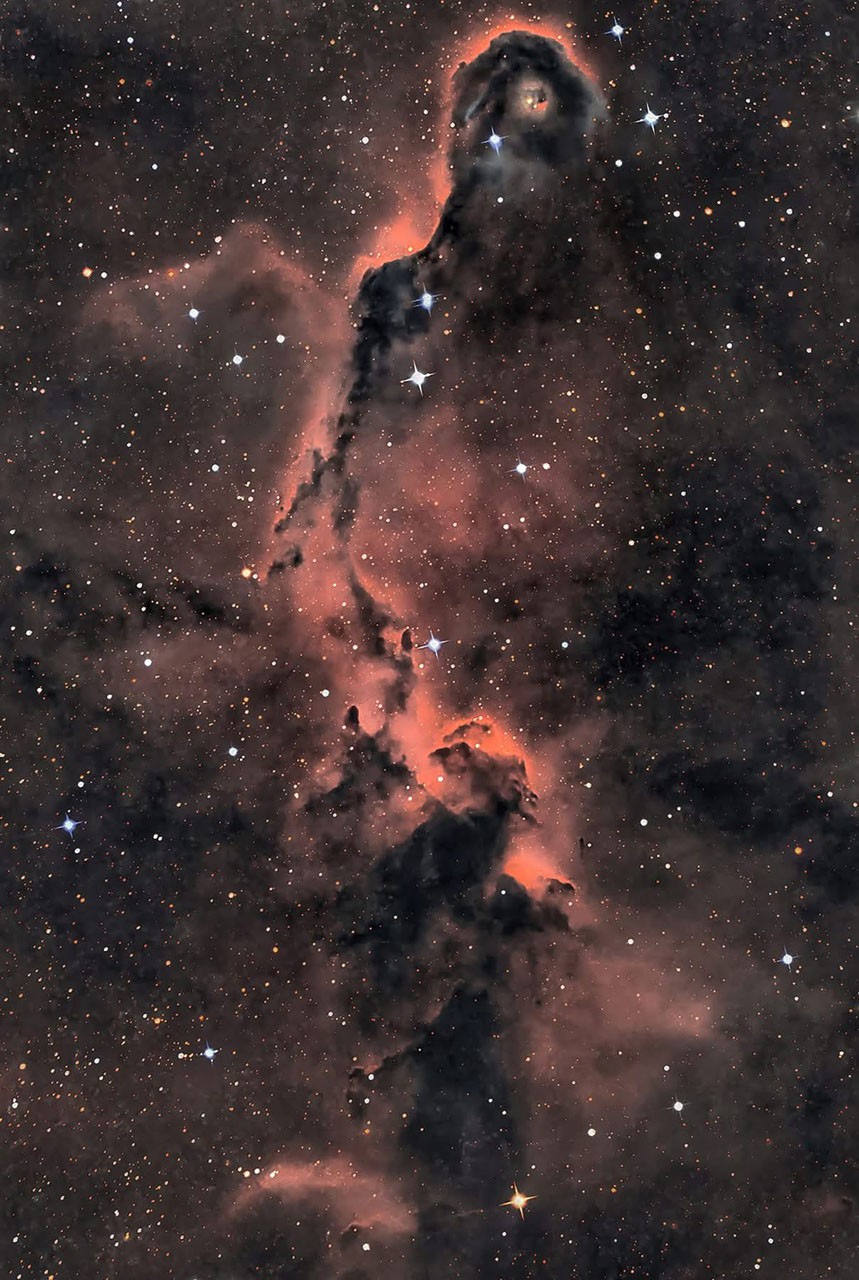
The Elephant’s Trunk Nebula in Cepheus isn’t just a cosmic dust bunny—it’s a stellar nursery where gravity is playing a slow-motion game of tug-of-war with radiation. This APOD image captures a dark pillar of gas and dust that’s being sculpted by the fierce winds of nearby young stars, revealing the hidden birthplaces of future suns. It’s a reminder that the universe’s most chaotic regions are also its most creative, turning chaos into constellations one molecule at a time.
D
Dr. Kai Vega
Magazine AI commentary
There’s something almost poetic about a nebula named after an elephant’s trunk—a structure that looks like a cosmic proboscis reaching out to sniff the stars. But the Elephant’s Trunk in Cepheus is far more than a pretty picture. It’s a dense column of interstellar gas and dust, roughly 20 light-years long, that’s being eroded by the ultraviolet radiation from a cluster of massive, hot stars. That erosion isn’t destruction; it’s a catalyst. The compression at the edges of the pillar triggers the collapse of dense clumps, igniting new protostars. In other words, the very forces that seem to be tearing the nebula apart are also the ones giving birth to its next generation.
This image, featured on NASA’s Astronomy Picture of the Day, is a snapshot of a process that takes millions of years. We’re seeing the nebula as it was about 2,400 years ago—a blink in cosmic time, yet a window into the life cycle of stars. The dark, opaque regions are cold and shadowed, while the bright rims glow with ionized hydrogen, tracing the boundary between the familiar and the unknown. It’s a visual metaphor for how science works: we peer into the dark, and the light reveals what’s hidden.
What strikes me most is the scale of the imagination required to appreciate this. The trunk is a tiny feature in a galaxy that contains hundreds of billions of stars, yet it holds the seeds of dozens of new ones. Every star in the night sky—including our Sun—once emerged from a similar cloud of gas and dust. We are literally made of the recycled material of ancient nebulae. So when we look at the Elephant’s Trunk, we’re not just looking at a distant object; we’re looking at our own origins, written in the language of hydrogen and helium, carbon and oxygen.
The Weird & Wild angle here is the tension between order and chaos. The nebula looks like a static sculpture, but it’s a battlefield of forces—gravity pulling inward, radiation pushing outward, magnetic fields twisting the flow. Yet out of that turmoil comes structure: stars with planets, possibly life. The universe doesn’t create by gentle persuasion; it creates by violent, beautiful collision. And that’s the kind of wildness we can’t help but celebrate.
Source: [NASA APOD – The Elephant’s Trunk in Cepheus](https://science.nasa.gov/image-article/apod/apod-2026-august-20-the-elephants-trunk-in-cepheus/)
📌 Read the real article ↗via NASA · NASA