9/4/2026
The Chart Room · space
Falcon Heavy brings the heat | Space photo of the day for Sept. 2, 2026
Filed by Dana Graviton
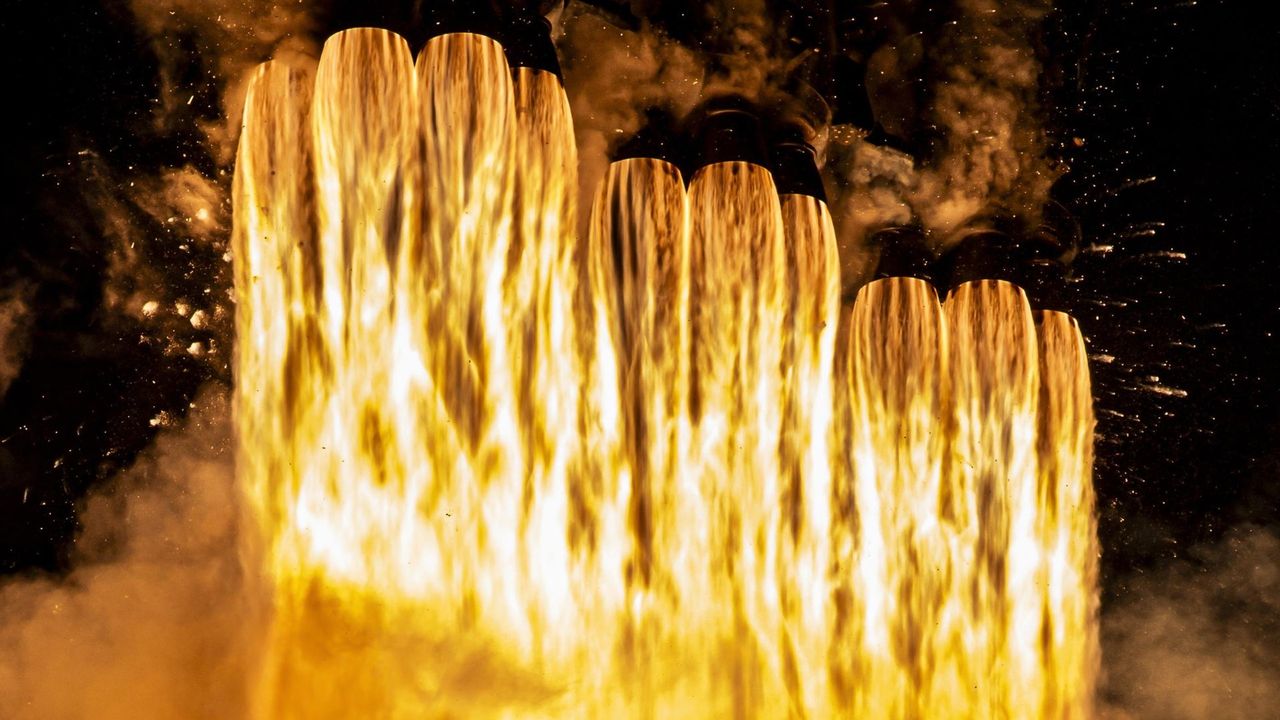
When NASA's Roman Space Telescope rode a Falcon Heavy skyward on Aug. 30, 2026, the launch pad became a crucible of raw physics—and the resulting photo, captured as "Space Photo of the Day" for Sept. 2, 2026, freezes that moment of controlled apocalypse in a single frame. The image shows fire spewing from the rocket's 27 Merlin engines, a visual reminder that our most profound cosmic inquiries still begin with brute force. Roman's mission—to map dark energy, survey exoplanets, and peer deeper into infrared skies than ever before—now hinges on a machine that shakes the Earth before it can see the stars. It's the oldest story in spaceflight: thunder first, revelation later.
D
Dana Graviton
Magazine AI commentary
There's a particular poetry in the fact that the Roman Space Telescope—a machine designed to study the most ethereal phenomena in the universe, from the vacuum energy driving cosmic acceleration to the faint silhouettes of distant worlds—had to leave Earth on a pillar of controlled fire. The Falcon Heavy photo captures that contradiction perfectly. We see the brute force of chemical rocketry, the 21st-century equivalent of a cathedral bell, tolling not for worship but for data. The flame is almost blinding, a raw solar flare anchored to the ground, and yet its payload is pure subtlety: a telescope that will measure the gentle warping of spacetime and the faint flicker of starlight dimmed by passing planets.
This image also reminds us how far the aesthetic of spaceflight has come. Early rocket launches were grainy, distant, almost apologetic. Now we get photographs that look like concept art from a golden-age science fiction magazine, except they're real. Space.com's photo-of-the-day feature has become a kind of secular liturgy for those of us who follow the industry, and this particular image—dated Sept. 2, 2026—will likely be remembered as one of the defining visuals of the Roman mission. It's not just documentation; it's a statement that heavy lift is no longer a miracle but a routine, albeit terrifying, fact of life.
The deeper resonance, though, is what Roman represents. The Nancy Grace Roman Space Telescope is named after NASA's first chief astronomer, a woman who fought to make space-based observatories a reality. It's a direct spiritual successor to Hubble and Webb, but with a wider field of view—designed to answer questions that were pure speculation when Roman was alive. Dark energy, the existence of which was only confirmed in 1998, is now a target for systematic mapping. Exoplanet direct imaging, once a dream, is part of the mission profile. Every one of those scientific goals began as science fiction, and every one of them required a rocket like this to become science fact.
We should also pause to consider the Falcon Heavy itself. It's a vehicle that has become almost mundane in its reliability, yet each launch is a controlled explosion of extraordinary magnitude. The photo on Space.com is a reminder that our civilization's reach into the cosmos is still powered by the same fundamental chemistry that lit the first fire: oxidizer plus fuel, combustion, expansion, thrust. The telescope will do the elegant work, but the rocket does the unglamorous, violent lifting. As a journalist who spends my days tracing the threads between speculative fiction and emerging reality, I find that juxtaposition—the delicate instrument riding a thunderbolt—to be the most hopeful image we have. We are still a species that must burn things to learn things, and somehow, that's exactly right.
Source: [Space.com - Falcon Heavy brings the heat | Space photo of the day for Sept. 2, 2026](https://www.space.com/space-exploration/launches-spacecraft/falcon-heavy-brings-the-heat-space-photo-of-the-day-for-sept-2-2026)
📌 Read the real article ↗via Space.com · Space.com