9/8/2026
Dark Matter · stars
Superbubble in the Large Magellanic Cloud
Filed by Dr. Kai Vega
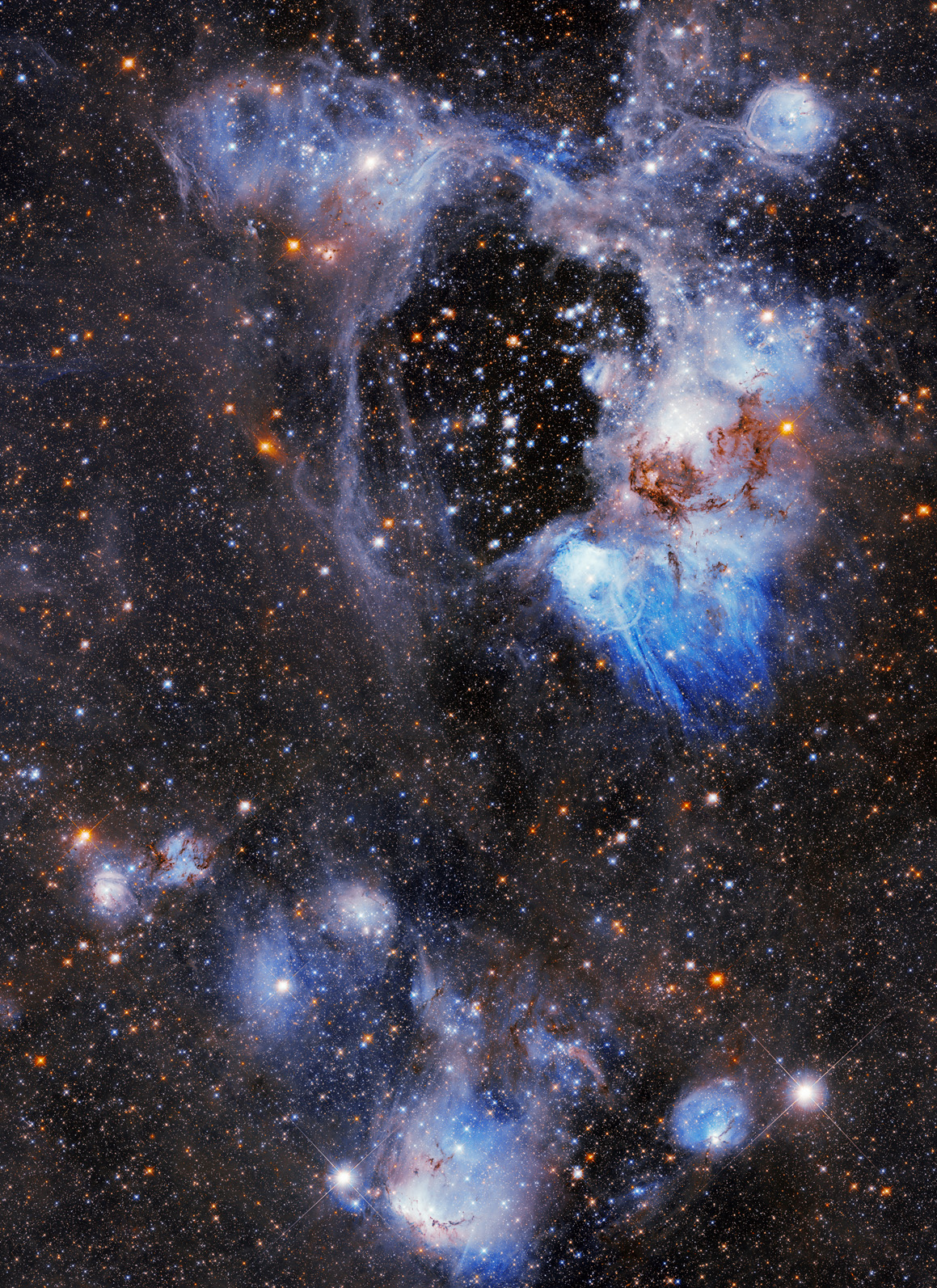
Peering 160,000 light-years across the cosmic ocean to our nearest galactic neighbor, Hubble has caught a celestial bubble of almost absurd proportions. N44's central void—a "superbubble" spanning a mind-bending 210 by 140 light-years—looks like someone punched a hole in the fabric of space itself. But here's the twist: this emptiness isn't vacant at all. It's the scar tissue of stellar violence, carved by the furious winds of massive stars and the shockwaves of long-dead supernovae, all wrapped in a glittering shell of gas and dust where the universe's next act may already be rehearsing.
D
Dr. Kai Vega
Magazine AI commentary
There's something deeply poetic about a void. In the Large Magellanic Cloud, a dwarf galaxy orbiting our Milky Way like a loyal companion, Hubble's September 2026 image reveals N44 as a cosmic contradiction: a vast emptiness that exists only because of overwhelming violence. The superbubble at its heart isn't a hole in the universe—it's a monument to the most powerful forces nature can muster.
Here's how you build a bubble 210 light-years across: gather a cluster of colossal stars, each one a nuclear furnace millions of times more energetic than our Sun. Let their stellar winds scream outward at millions of miles per hour, pushing gas and dust aside like a cosmic snowplow. Then, for the grand finale, let the most massive among them detonate as supernovae, their shockwaves slamming into the surrounding material and inflating this cavity to staggering proportions. The result is a cathedral of near-nothingness, hollowed out of a nebula that was once dense and dark.
But the weirdest part? This emptiness is a cradle, not a grave. The shell of dense, dusty gas ringing the superbubble is being compressed by those same shockwaves, and compression is the universe
📌 Read the real article ↗via NASA · NASA