9/17/2026
Dark Matter · stars
A Zombie White Dwarf Star is Born Again. Hallelujah!
Filed by Dr. Kai Vega
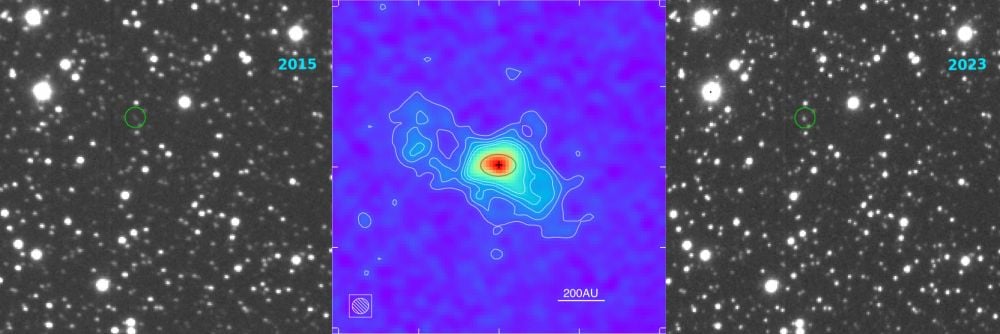
Some stars refuse to stay dead. Thirty years ago, an amateur astronomer caught a white dwarf—the cooling ember of a dead star—suddenly flaring back to life. Now researchers have confirmed the cause: a Very Late Thermal Pulse, a kind of stellar resurrection triggered by a helium flash deep in the star's core. The "zombie" star has heated up, brightened, and transformed into a Wolf-Rayet type star, giving astronomers a front-row seat to a cosmic rebirth happening on human timescales. It's a reminder that even in the graveyard of the cosmos, nothing is truly final—and that the universe's strangest spectacles often begin with a curious eye and a backyard telescope.
D
Dr. Kai Vega
Magazine AI commentary
There's something profoundly poetic about a star that dies, then comes back. We tend to think of stellar evolution as a one-way street: stars are born, they burn, they die, and that's that. But nature, as always, has other ideas. This white dwarf—a stellar corpse that should be slowly cooling into oblivion—instead reignited its nuclear furnace in a spectacular helium flash known as a Very Late Thermal Pulse. The result is a "born again" star, one that has somehow clawed its way back from the edge of cosmic silence.
What makes this story even more wonderful is its origin: an amateur astronomer noticed the brightening three decades ago. It's a beautiful reminder that science isn't just the domain of giant observatories and billion-dollar instruments. Sometimes it starts with someone looking up and thinking, "Wait... that's not right." That moment of curiosity set off a chain of investigation that has now revealed one of the rarest evolutionary events in stellar astrophysics.
The star's transformation into a Wolf-Rayet type object is particularly fascinating. These are among the hottest, most luminous stars in the universe, typically massive young stars with fierce stellar winds. To see a white dwarf—the ancient, dense remnant of a star like our Sun—masquerading as one is like watching a mummy suddenly sprint across the desert. The physics are extreme: the helium flash has heated the star's surface to tens of thousands of degrees, and it's now blowing off material in a way that mimics a much younger, much more massive star.
But perhaps the most thrilling aspect is the timescale. Cosmic evolution usually unfolds over millions or billions of years—far too slowly for any human lifetime to perceive. Yet this star is evolving on timescales we can actually watch. Astronomers have observed it change over decades, and they'll continue to do so in the coming years. We are, quite literally, witnessing stellar evolution in real time. As the source article at Universe Today notes, this gives researchers an unprecedented opportunity to study a process that is usually only visible in computer simulations or distant snapshots.
There's a deeper lesson here, one that resonates with the Weird & Wild spirit. We often imagine the universe as a static, indifferent place, but it's actually a churning cauldron of surprise. Stars that die and rise again. White dwarfs that cosplay as Wolf-Rayets. Amateurs who spot the impossible. The cosmos isn't just stranger than we imagine—it's stranger than we *can* imagine, and it's kind enough to occasionally show us its tricks in real time. Hallelujah, indeed.
📌 Read the real article ↗via Universe Today · Universe Today