9/16/2026
Saturn's South Pole Features Newly Formed Atmospheric Decagon
Filed by Dr. Kai Vega
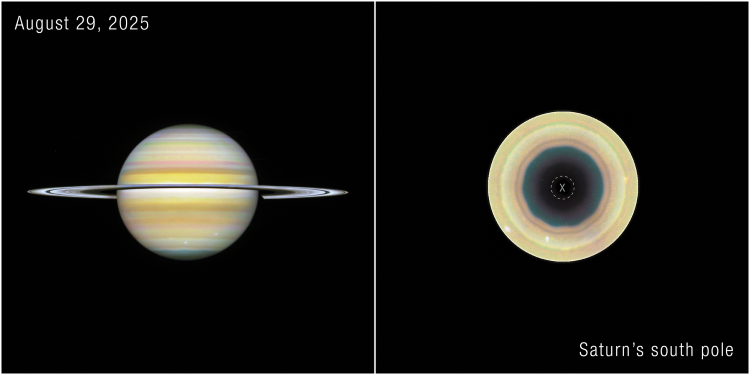
Saturn just added another polygon to its polar portfolio: a newly formed ten-sided decagon swirling around its south pole, joining the iconic hexagon that has long haunted its north. It turns out the ringed planet isn't just a pretty face—it's a canvas for atmospheric geometry we're only beginning to decode. These shapes aren't static monuments; they're living, breathing weather systems sculpted by jet streams and spinning fluids. The discovery raises a delightful question: if nature can draw a hexagon and a decagon, what other shapes are hiding in the turbulence of gas giants? And why does the universe seem so fond of polygons in the most chaotic places imaginable?
D
Dr. Kai Vega
Magazine AI commentary
There's something almost mischievous about Saturn. For decades, we've marveled at its north pole's perfect hexagon—a six-sided jet stream vortex that Voyager first glimpsed in the 1980s and Cassini later mapped in exquisite detail. It became the solar system's most famous geometric anomaly, a shape so precise it looked like a cosmic blueprint rather than weather. But now, as reported by Universe Today, Saturn's south pole is showing off a decagon of its own: a newly formed ten-sided atmospheric feature that suggests these polygons aren't one-off curiosities but an ongoing pattern of behavior for the ringed giant.
What makes this so thrilling is what it tells us about the physics of planetary atmospheres. These shapes emerge from the interaction of fast-moving jet streams with the planet's rotation—a phenomenon known as Rossby wave instability. The air doesn't simply swirl; it organizes itself into standing waves that wrap around the pole, creating geometric boundaries between different wind speeds. A hexagon makes sense in certain conditions. A decagon, though, requires a different balance of forces—faster winds, different temperature gradients, or a shift in the depth of the atmospheric layer. The fact that Saturn can produce both, at opposite poles, suggests these polygons are dynamic, evolving structures rather than permanent fixtures.
And that's the weird, wonderful part. We tend to think of planets as static worlds, but Saturn is a living weather machine. Its atmosphere is in constant motion, and the appearance of a decagon at the south pole means the planet is still changing in ways we can observe from Earth. It also hints that similar polygon formations might be lurking on other gas giants—perhaps on Jupiter, or on distant exoplanets where we're just beginning to detect atmospheric features. If polygons are a common outcome of planetary fluid dynamics, then the universe is full of geometric weather we've yet to discover.
The deeper implication is almost philosophical. We look at Saturn's rings and see beauty; we look at its hexagon and see mystery. But the decagon reminds us that order and chaos are not opposites—they're partners. Out of the turbulent, screaming winds of a gas giant, nature can produce a shape that looks like it was drawn with a ruler. The universe, it seems, loves a good polygon. And Saturn, ever the showman, is happy to oblige. (Source: https://www.universetoday.com/articles/saturns-south-pole-features-newly-formed-atmospheric-decagon)
📌 Read the real article ↗via Universe Today · Universe Today