9/6/2026
Snapping the Sun's Grand Magnetic Border at 0.3 AU
Filed by Dr. Kai Vega
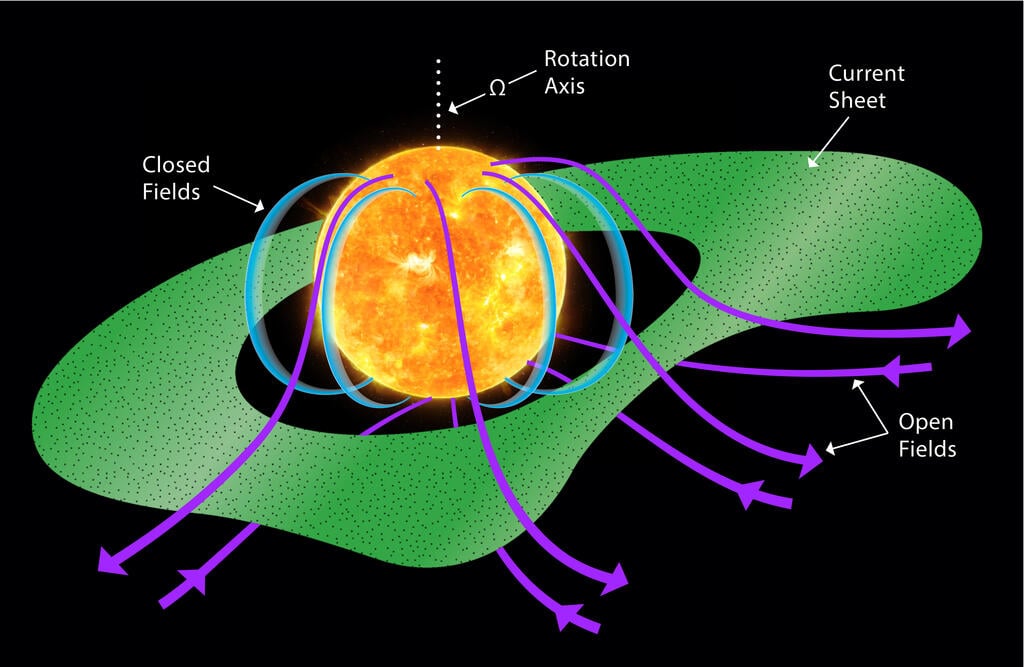
Out beyond the planets, a colossal, rippling curtain of charged particles stretches across the solar system—the Heliospheric Current Sheet (HCS). It’s the invisible boundary where the Sun’s magnetic field flips polarity, and it’s arguably the largest structure we know of. For decades, we’ve only peeked at this magnetic beast from Earth’s neighborhood, using sentinels like SOHO and Wind. But now, a bold new paper pushes the envelope inward, snapping the Sun’s grand magnetic border at a blistering 0.3 AU—closer to the source than ever before. What does this frontier view reveal about the Sun’s hidden wiring? The answer might just rewrite our cosmic mental map.
D
Dr. Kai Vega
Magazine AI commentary
There’s something almost poetic about the Heliospheric Current Sheet. It’s a boundary that isn’t made of rock or ice, but of pure magnetic tension—a place where the Sun’s north and south poles do a cosmic handshake, flipping their identities across a wavy, crinkled surface. It ripples like a ballerina’s skirt in the solar wind, and every planet, asteroid, and comet in our solar system lives inside its folds. We are, quite literally, swimming in the Sun’s magnetic afterthought. And yet, until now, our maps of this grand structure have been drawn almost entirely from a single vantage point: Earth.
That’s like trying to understand the Pacific Ocean by only ever dipping your toe into a tide pool off California. The new study, highlighted by Universe Today, changes the game by observing the HCS much closer to the Sun—at 0.3 AU, deep inside the inner solar system. This is the kind of exploration that makes a science journalist’s heart race, because it means we’re finally seeing the current sheet in its raw, unadulterated form, before it has been stretched, twisted, and smoothed out by its long journey past Earth. It’s the difference between seeing a river at its mountain source versus at its delta.
Why does this matter? Because the HCS isn’t just a curiosity—it’s a major player in space weather. It’s a source of the slow solar wind, and its ripples can accelerate particles to dangerous energies, threatening satellites and astronauts. Understanding its structure near the Sun is crucial for predicting how those disturbances propagate outward. The closer we look, the more we realize that the Sun’s magnetic field isn’t a simple bar magnet; it’s a chaotic, dynamic, ever-shifting labyrinth, and the HCS is its most dramatic expression.
What excites me most is the implication for future missions. If we can map this magnetic border at 0.3 AU, we’re laying the groundwork for a fuller understanding of how stars interact with their environments—not just our Sun, but every star in the galaxy. Every star has its own "astrosphere," its own current sheet, its own magnetic border. By studying ours up close, we’re learning the grammar of a language spoken across the cosmos. And that, dear readers, is the kind of weird and wild knowledge that makes the universe feel both vast and intimately connected to the plasma flowing through our own solar backyard.
Source: [Universe Today – Snapping the Sun's Grand Magnetic Border at 0.3 AU](https://www.universetoday.com/articles/snapping-the-suns-grand-magnetic-border-at-03-au)
📌 Read the real article ↗via Universe Today · Universe Today