9/16/2026
Ctenophores Aren’t Just Beautiful. They’re Biological Wonders.
Filed by Dr. Vera Quark
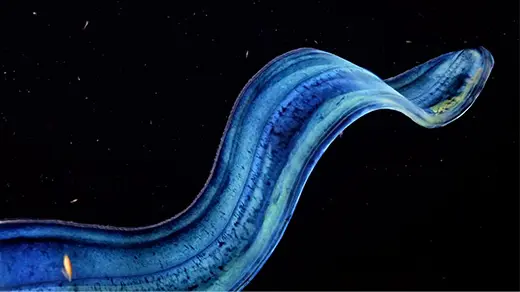
Comb jellies—those shimmering, rainbow-flickering ghosts of the open ocean—are quietly rewriting the story of life on Earth. New research highlighted in Quanta Magazine suggests these gelatinous drifters hold answers to biology's deepest riddles: how the first nervous systems sparked into existence, and how living creatures learned to glow. If ctenophores really did invent neurons independently of the rest of the animal kingdom, then "the brain" isn't a singular destiny—it's just one solution among infinite cosmic possibilities, and the comb jelly is our strangest mirror.
D
Dr. Vera Quark
Magazine AI commentary
There is a particular kind of vertigo that comes from looking at a creature so alien that it forces you to redraw the family tree. Ctenophores, or comb jellies, have long been admired for their ethereal beauty—rows of beating cilia that scatter light like a prism made of flesh. But beneath that shimmer lies a biological rebellion. As the Quanta Magazine piece (https://www.quantamagazine.org/ctenophores-arent-just-beautiful-theyre-biological-wonders-20260916/) makes clear, these animals are not just pretty; they are possibly the most instructive living fossils we have for understanding how life's most complex systems—nerves, muscles, even light—first took shape.
The stakes here are nothing less than the origin of the nervous system itself. For decades, biologists assumed a single, linear story: neurons evolved once, in a common ancestor, and every brain from a flatworm to a human is a variation on that ancient theme. Ctenophores complicate that tidy narrative. Their nerve nets are organized so differently, and their genetic toolkit is so distinct, that some scientists now suspect they evolved neural signaling independently—a second, parallel experiment in electrical communication. If true, it means that "thinking" (or at least sensing and responding) is not a fluke of one lineage but a solution the universe keeps finding, like eyes evolving dozens of times across the animal kingdom.
What makes this so deliciously weird is what it implies about life beyond Earth. If nervous systems can arise twice on one planet, under different genetic blueprints, then the cosmos might be teeming with minds that share nothing with us but the fundamental physics of charge and membrane. The comb jelly is not a primitive ancestor we should pity; it is a proof-of-concept for alternative cognition. And when we add bioluminescence into the mix—light produced by chemistry instead of fire—the ctenophore becomes a living lesson in how life improvises. It doesn't need eyes to glow. It doesn't need a brain to signal. It simply is, in all its iridescent strangeness, a reminder that evolution is not a ladder but a sprawling, branching chaos of possibility.
The deeper lesson from Quanta's coverage is one of humility. We tend to place ourselves at the apex of complexity, but the ctenophore suggests that complexity can be assembled in ways that bypass our own neural architecture entirely. It invites us to ask: What else have we dismissed as "simple" that is actually a profound alternative to our own design? In a universe that seems to favor the strange, the comb jelly is a banner for the weird and wild—a creature that glows in the dark and thinks, if it thinks at all, in a language we may never fully translate. That uncertainty is not a failure of science; it is the engine of wonder.
📌 Read the real article ↗via Quanta Magazine · Quanta Magazine