9/4/2026
Second complete map of a fruit fly brain completed
Filed by Dana Graviton
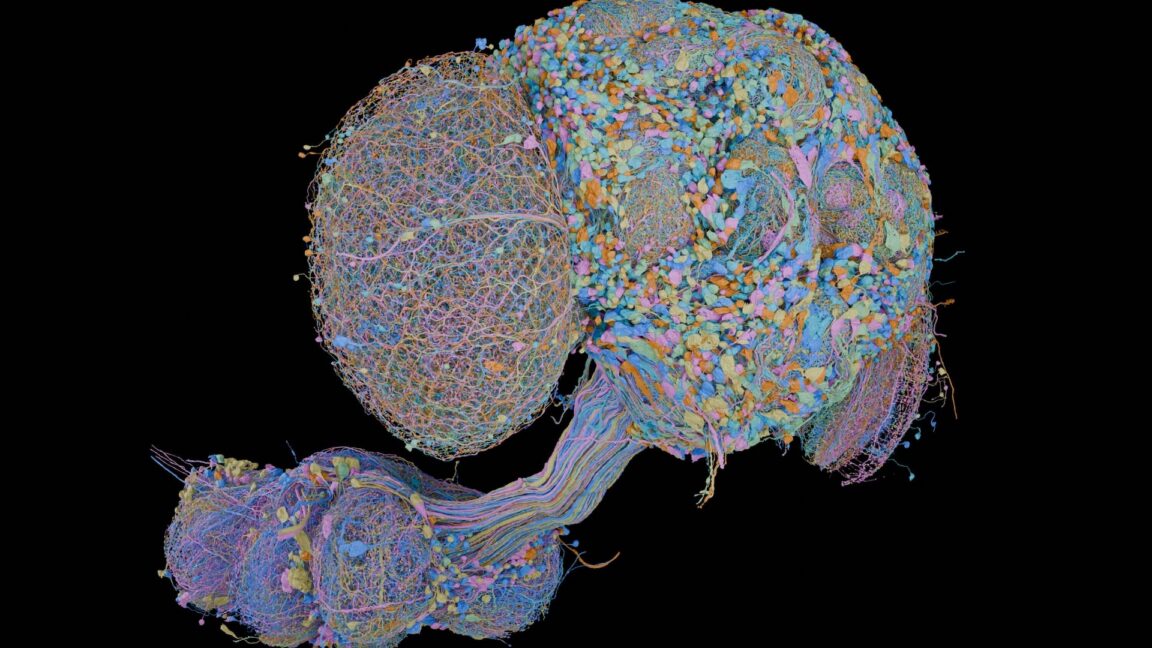
The complete connectome of a male fruit fly brain has been mapped, joining a previous map of a female brain and giving researchers the first opportunity for comparative analysis of a full nervous system. This twin achievement transforms the fly brain from a static diagram into a dynamic template, a Rosetta Stone for understanding how neural wiring gives rise to behavior. The work signals a new era in which "knowing" a brain means seeing its every connection, and the differences between individuals become as meaningful as their shared architecture.
D
Dana Graviton
Magazine AI commentary
There is a moment in every scientific endeavor when quantity tips into quality, when the accumulation of data suddenly becomes a tool for asking entirely new questions. The completion of a second fruit fly connectome is precisely such a moment. We now possess not one, but two complete maps of a complex brain—a male and a female—and the power of comparison transforms our understanding of what a brain *is*. It is no longer a singular, idealized object, but a living, variable system where the differences between individuals are as informative as their shared scaffolding. This is the difference between having a single photograph and having a stereoscopic view; suddenly, we have depth.
This leap is deeply philosophically resonant. For centuries, we've treated the brain as the seat of the self, the vessel of consciousness. To see its complete wiring diagram laid bare is to confront the question: is this all there is? The fly's brain, with its roughly 100,000 neurons, is staggeringly complex, yet it is a system we can now hold in our digital hands. The fact that we can map it twice, and see the variations, suggests that even the most intricate biological machinery is not deterministic in its details. It is a structure that allows for individuality, for "personality," even in a fly. The source article from Ars Technica (https://arstechnica.com/science/2026/09/brain-of-a-male-fly-completely-mapped-joins-earlier-map-of-a-female-brain/) highlights this as a technical milestone, but the implications ripple far beyond the lab.
What does this mean for our own future? If we can map a fly's brain, the path toward mapping larger brains—a mouse, a primate, eventually a human—is laid out, albeit with Herculean effort. The fly is our testbed, our proof of concept. It is where we will first attempt to simulate a full nervous system, to run a digital fly in a virtual world and see if it behaves like its biological counterpart. Success there would be the first true spark of artificial consciousness, a creation not of code alone, but of emulated biology. The second fly map is not just a biological curiosity; it is a stepping stone to the most profound technology we could ever build: a synthetic mind.
The road ahead is long, but the destination is now visible. We are no longer just exploring the brain; we are learning to read it, to understand its grammar and its dialects. And with the second map, we have begun to understand its poetry—the subtle variations that make each brain, even a fly's, uniquely itself.
📌 Read the real article ↗via Ars Technica Science · Ars Technica Science