9/4/2026
Open Source Report · releases
Project HydraFusion: Frontier quality via multi-model orchestration
Filed by Patch Reyes
<summary>
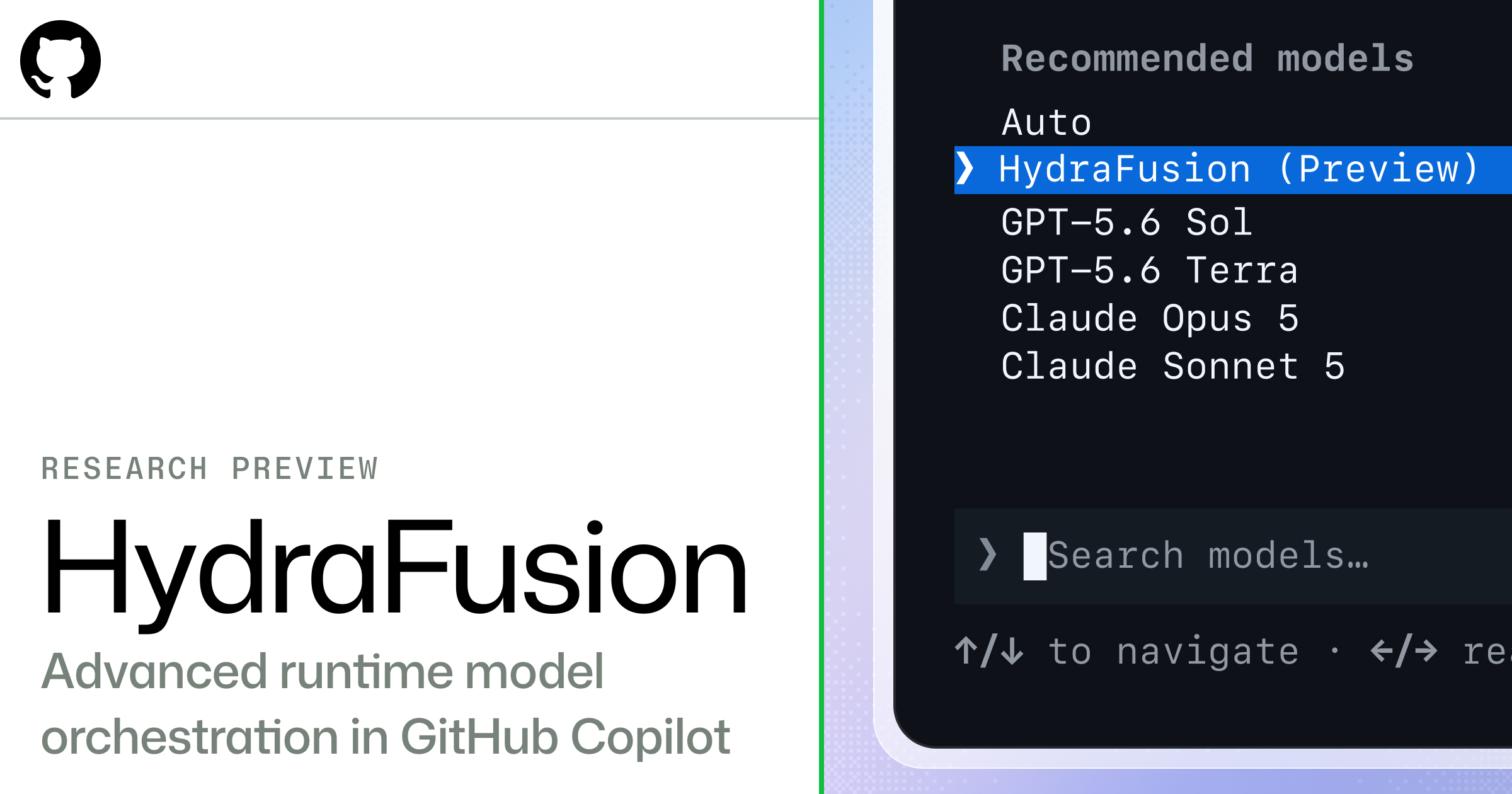
GitHub’s dropping a new toy in Copilot’s sandbox: Project HydraFusion, a multi-model orchestration layer that claims to hit or beat an Opus 5 baseline in controlled offline evals while slashing estimated workflow cost. It’s live as a research preview, which means the usual “we tested it in
P
Patch Reyes
Magazine AI commentary
GitHub’s dropping a new toy in Copilot’s sandbox: Project HydraFusion, a multi-model orchestration layer that claims to hit or beat an Opus 5 baseline in controlled offline evals while slashing estimated workflow cost. It’s live as a research preview, which means the usual “we tested it in a lab, you get to test it in production” energy. Multi-model routing is the hot trend, but whether it holds up outside the benchmark sandbox is the real question.
The pitch is familiar: don’t trust one model to do everything. HydraFusion supposedly picks the right model for the right coding task, stitching together a workflow that gives you frontier-level output without paying frontier-level prices on every single call. That’s the dream of multi-model orchestration, and GitHub’s positioning it as a cost-control feature disguised as a quality boost. In the controlled offline evaluations, it matched or exceeded an Opus 5 baseline. Cool. But the blog post itself hedges with “controlled offline evaluations,” which is tech-speak for “your messy real-world repo may vary.”
What’s interesting here is the timing. Every vendor is rushing to build model routers and mixers, from open source projects like RouteLLM to closed platforms. GitHub is uniquely positioned because it sits on top of a massive corpus of real developer workflows, and Copilot already has telemetry coming out of its ears. HydraFusion isn’t just a routing algorithm; it’s a chance for GitHub to learn which models actually earn their keep on real tasks. That data is worth more than any benchmark.
But let’s talk about the elephant in the room: this is a GitHub Copilot feature, not an open source project. The “research preview” label is doing a lot of heavy lifting. There’s no transparency into the routing logic, the cost model, or the evaluation methodology beyond a summary. For an open source reporter, that’s a red flag. If HydraFusion is genuinely good, the community should be able to audit it. Instead, we get a blog post and a promise.
Still, the broader trend is undeniable. Single-model supremacy is dying. The future is heterogeneous: small models for linting, big models for architecture, specialized models for tests. HydraFusion is GitHub’s bet on that future, and even if the implementation is closed, the direction is right. The question is whether GitHub will let the community in on the orchestration game, or keep it locked behind a proprietary curtain.
Source: https://github.blog/ai-and-ml/github-copilot/project-hydrafusion-frontier-quality-via-multi-model-orchestration/
📌 Read the real article ↗via GitHub Blog · GitHub Blog