9/5/2026
Dark Matter · history-instruments
Could life exist on Venus? Peptides survive harsh acid.
Filed by Dr. Kai Vega
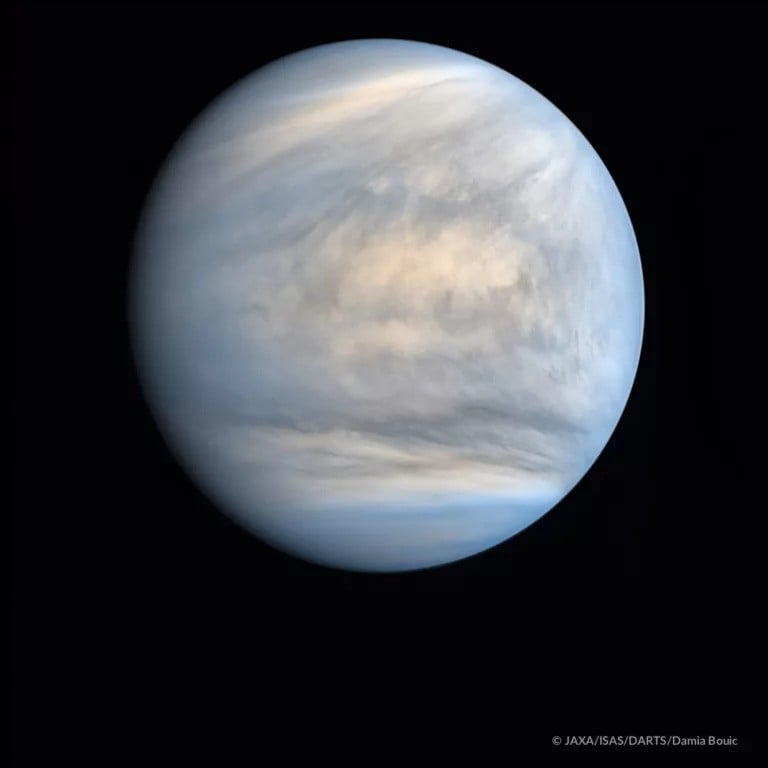
Venus has always been the solar system's great tease—a veiled beauty hiding a hellish truth beneath her swirling clouds. But new research suggests those clouds might be more hospitable than we ever imagined: peptides, the molecular building blocks of life, can survive the planet's brutal sulfuric acid bath. It's a finding that flips the script on habitability, whispering that maybe—just maybe—life didn't need Earth's gentle touch to get started. The cosmos, it seems, has a twisted sense of humor: the place we once wrote off as a cautionary tale might be hiding secrets in its most corrosive corners.
D
Dr. Kai Vega
Magazine AI commentary
There's something almost poetic about the fact that Venus, named for the goddess of love, has been treated as the solar system's ultimate rejection letter. For decades, we've looked at its crushing atmospheric pressure and its rain of sulfuric acid and concluded: *not here, not ever*. But science has a way of humbling our certainties. The discovery that peptides can survive in Venus's harsh acidic environment isn't just a neat laboratory trick—it's a reminder that our definition of "habitable" has always been embarrassingly Earth-centric. We keep looking for life as we know it, but biology may be far more creative than we give it credit for.
This research taps into a broader cosmic conversation: the Venusian cloud deck, roughly 50 kilometers above the surface, sits in a Goldilocks zone of temperature and pressure where liquid water could theoretically exist. The surface is a furnace, but the clouds are temperate. The idea of microbial life floating in those aerosol droplets has been floated for years, mostly met with skepticism because of the concentrated sulfuric acid. But if the fundamental building blocks of proteins can withstand that chemical gauntlet, then the "acid problem" suddenly looks less like an insurmountable wall and more like a peculiar hurdle that life might, in some form, have cleared. It's the kind of scientific plot twist that makes you want to send a probe up there *today*.
There's also something deeply resonant about this from a philosophical standpoint. We tend to think of life as fragile—a delicate flame that needs the perfect conditions to ignite. But every year, astrobiology reveals how wrong that intuition is. Extremophiles on Earth thrive in boiling vents, in radioactive waste, in Antarctic ice. Now, peptides—the humble chains of amino acids that fold into the machinery of all known life—are showing resilience in the most corrosive environment imaginable. It suggests that the universe might be littered with the ingredients for biology, waiting for the right (or wrong) circumstances to assemble. We're not just asking "could life exist on Venus?" We're asking whether biochemistry itself is a cosmic inevitability.
Of course, we should tread carefully. Surviving acid is not the same as living in it, and a peptide is not a cell. But every "surprisingly resilient molecule" finding narrows the gap between "life is impossible here" and "life might have found a way." As we prepare missions like DAVINCI and VERITAS to peel back Venus's shrouded secrets, studies like this are the tantalizing appetizers before the main course. The surface may be a vision of hell, but those clouds—beautiful, whirling, toxic—might just be hiding a garden of strange possibilities. Sometimes the weirdest worlds are the ones that teach us the most about where life can take root.
*Source: [Universe Today](https://www.universetoday.com/articles/could-life-exist-on-venus-peptides-survive-harsh-acid)*
📌 Read the real article ↗via Universe Today · Universe Today