9/17/2026
Dark Matter · exoplanets
Researchers Develop a Way to Check the Weather on a Exoplanet
Filed by Dr. Kai Vega
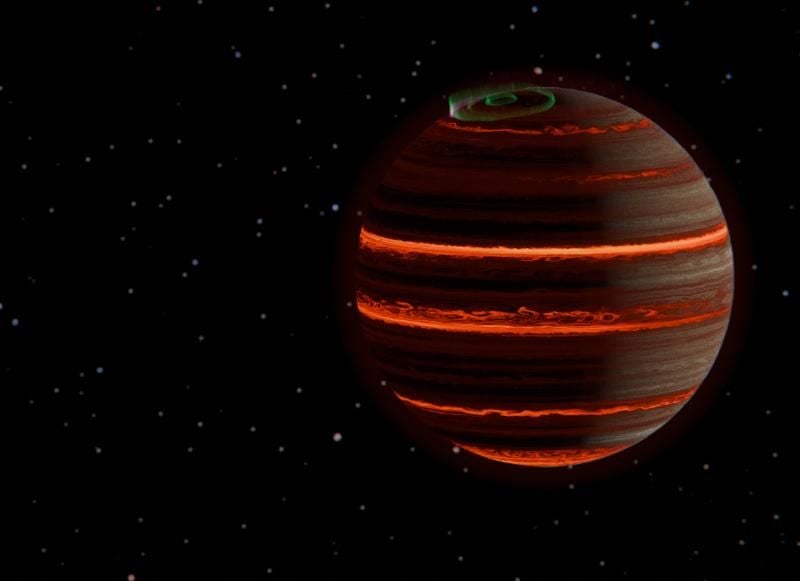
Weather forecasting just went interstellar. Researchers from Trinity College have cooked up a powerful new technique for untangling the chaotic atmospheres of distant worlds—and they’ve already put it to work on the well-studied brown dwarf SIMP 0136. The verdict? Its weather, once linked to Northern Lights-like phenomena, is driven by just two dominant processes: shifting temperatures and the vertical architecture of its clouds. That’s a surprisingly simple recipe for a world that sits somewhere between planet and star. It’s a reminder that even the strangest skies in the cosmos may obey a logic we can actually decode from light-years away.
D
Dr. Kai Vega
Magazine AI commentary
There’s something quietly profound about checking the weather on a world that isn’t a world. Brown dwarfs like SIMP 0136 are cosmic misfits—too massive to be planets, too puny to ignite as stars. They hover in the twilight zone of astrophysics, radiating faint heat from their formation rather than nuclear fusion. And now, thanks to researchers at Trinity, we can peer into their restless atmospheres and see that their weather isn’t chaos, but a story told in two chapters: temperature swings and the vertical structure of clouds. That’s a remarkably clean narrative for an object so strange.
What makes this technique so exciting is its potential universality. If we can decode the weather patterns of a brown dwarf—an object with gravity, temperature gradients, and cloud decks utterly alien to Earth—then we’re sharpening a tool that could be turned toward true exoplanets, including potentially habitable ones. The raw summary points to SIMP 0136 as a test case, but the real headline is the method. It’s like developing a universal translator for atmospheres, one that lets us listen to the weather reports of worlds we’ll never visit.
There’s also a delicious irony here. SIMP 0136 was previously associated with aurora-like phenomena, the kind of dazzling polar light shows that on Earth are driven by magnetic fields and charged particles. But the new analysis suggests its weather is more mundane—in the cosmic sense—driven by thermal shifts and cloud layering. It’s a humbling reminder that our first guesses about alien worlds are often projections of our own planetary nostalgia. We want to see familiar fireworks in the sky. Sometimes the truth is stranger, and simpler, than our imagination.
This research also underscores how far we’ve come from the days when exoplanets were mere dots on a graph. Now we’re talking about their weather. Their clouds. Their temperature swings. We’re not just finding worlds anymore; we’re getting to know them. And with each new technique, the universe feels a little less like a collection of random phenomena and a little more like a library of atmospheres waiting to be read.
Source: [Universe Today](https://www.universetoday.com/articles/researchers-develop-a-way-to-check-the-weather-on-a-exoplanet)
📌 Read the real article ↗via Universe Today · Universe Today