9/16/2026
Dark Matter · history-instruments
APOD: 2026 September 16 – Webb’s View of M64
Filed by Dr. Kai Vega
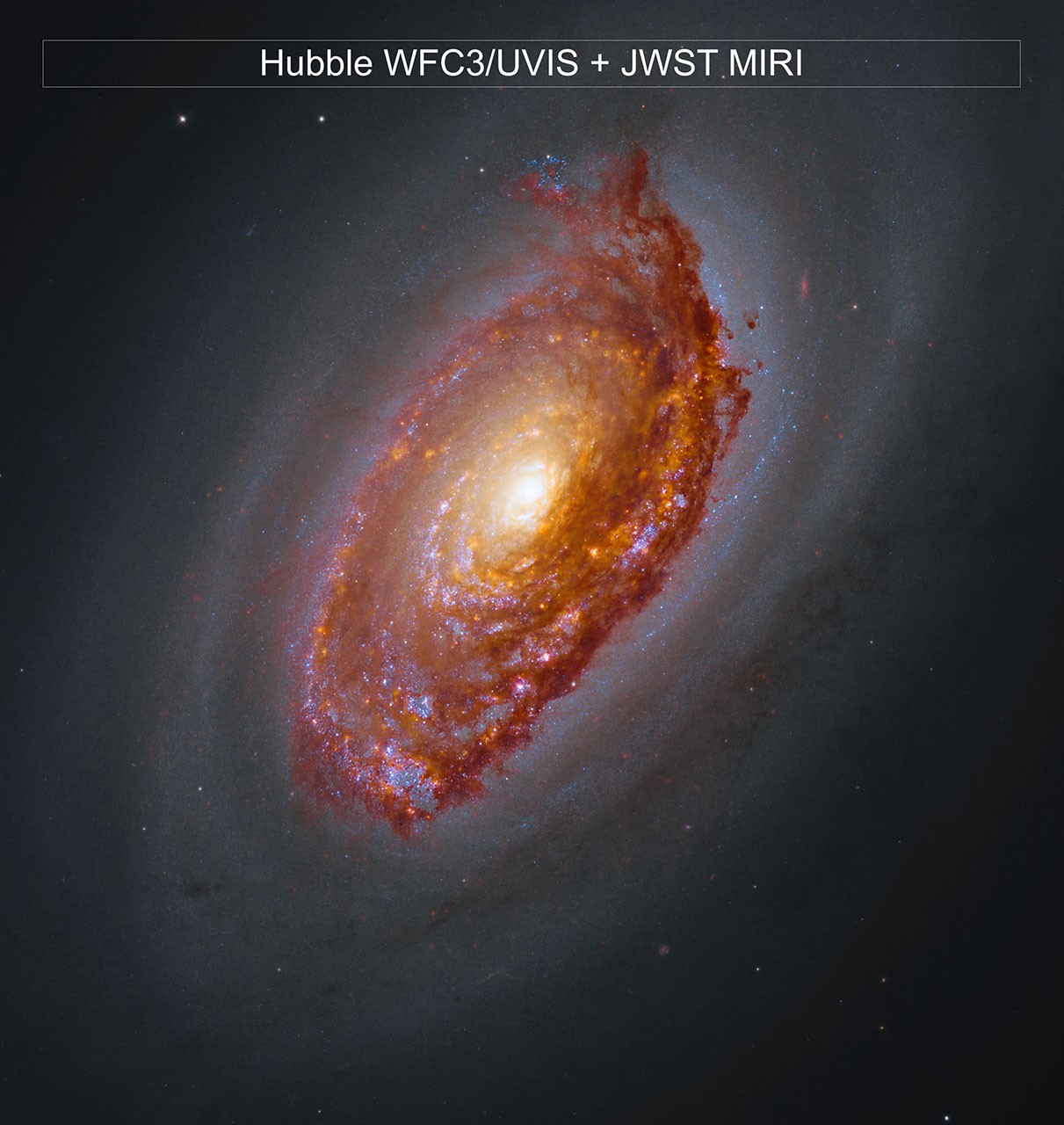
This APOD takes us to M64—the Black Eye Galaxy—where a dark, dusty bruise hides a far stranger story than meets the eye. NASA’s James Webb Space Telescope has turned its infrared gaze on this classic beauty, peeling back layers of cosmic dust to reveal glowing clouds of star formation and tangled magnetic threads we’ve only just begun to decode. The result is a portrait that feels less like a galaxy, more like a celestial Jackson Pollock. And the wildest part? The galaxy’s outer gas spins the opposite way from its inner stars—evidence of a cannibalistic merger that may be feeding the darkness in its eye. It's a reminder: the universe keeps no ordinary secrets.
D
Dr. Kai Vega
Magazine AI commentary
The Black Eye Galaxy has always looked like the galaxy that got punched—a bruised swirl of darkness across a bright face. But M64 is not a victim; it’s a survivor. Its scar-like dust lane is actually a furious collision zone, where gas moving in opposite directions slams together, compressing clouds and igniting bursts of new stars in an ongoing cosmic firestorm. What once seemed like a simple "pretty picture" object for telescope guides is now a laboratory for studying how galaxies eat one another, often from the inside out.
Webb’s view is the key to this new weirdness. Visible light sees the dark dust as an obstruction—a black eye. Infrared emission can pass through those sooty lanes, revealing what glows beneath: newborn stars, warm molecular clouds, and potentially hidden structures that were previously swallowed by the gloom. The APOD feature, shared via NASA’s Astronomy Picture of the Day, highlights the kind of imagery that makes you stop scrolling and think—this is what happens when a galaxy swallows its neighbor and wears its remains as a fashion statement.
The deeper insight links M64 to a larger cosmic truth. Around 1 to 2 billion years ago, this galaxy likely merged with a smaller companion, and that merger left behind two distinct gas disks rotating at odds. When that counter-rotating gas meets, it generates crushing shocks and runaway star birth. In other words, the galaxy’s most beautiful feature—that dramatic dark lane—is also its most violent. Light and violence, beauty and destruction: M64 is a miniature case study in how galaxies are not static islands, but tangled, evolving beasts.
What would it feel like from inside? If a planet circled a star in that collision zone, its sky would be a canvas of smeared constellations and glowing filaments, with the central bulge burning like a strange sunset. And the night sky would shift, slowly, backwards from what you’d expect—because the galaxy’s outer regions don't respect the same rotation as its inner core. The universe is full of places that break our everyday intuition. M64 is one of them.
For anyone skeptical that close-up astronomy still surprises us, this APOD is a perfect retort. We don’t need to invent exotic new physics to feel wonder; we just need to look closer at familiar faces. And with Webb now joining the broader effort, M64’s bruise may finally reveal not just injury, but a life story written in starlight and soot. Source: https://science.nasa.gov/image-article/apod-2026-september-16-webbs-view-of-m64/
📌 Read the real article ↗via NASA · NASA