9/13/2026
Venus’s pale yellow clouds may hide something surprisingly dark
Filed by Dr. Kai Vega
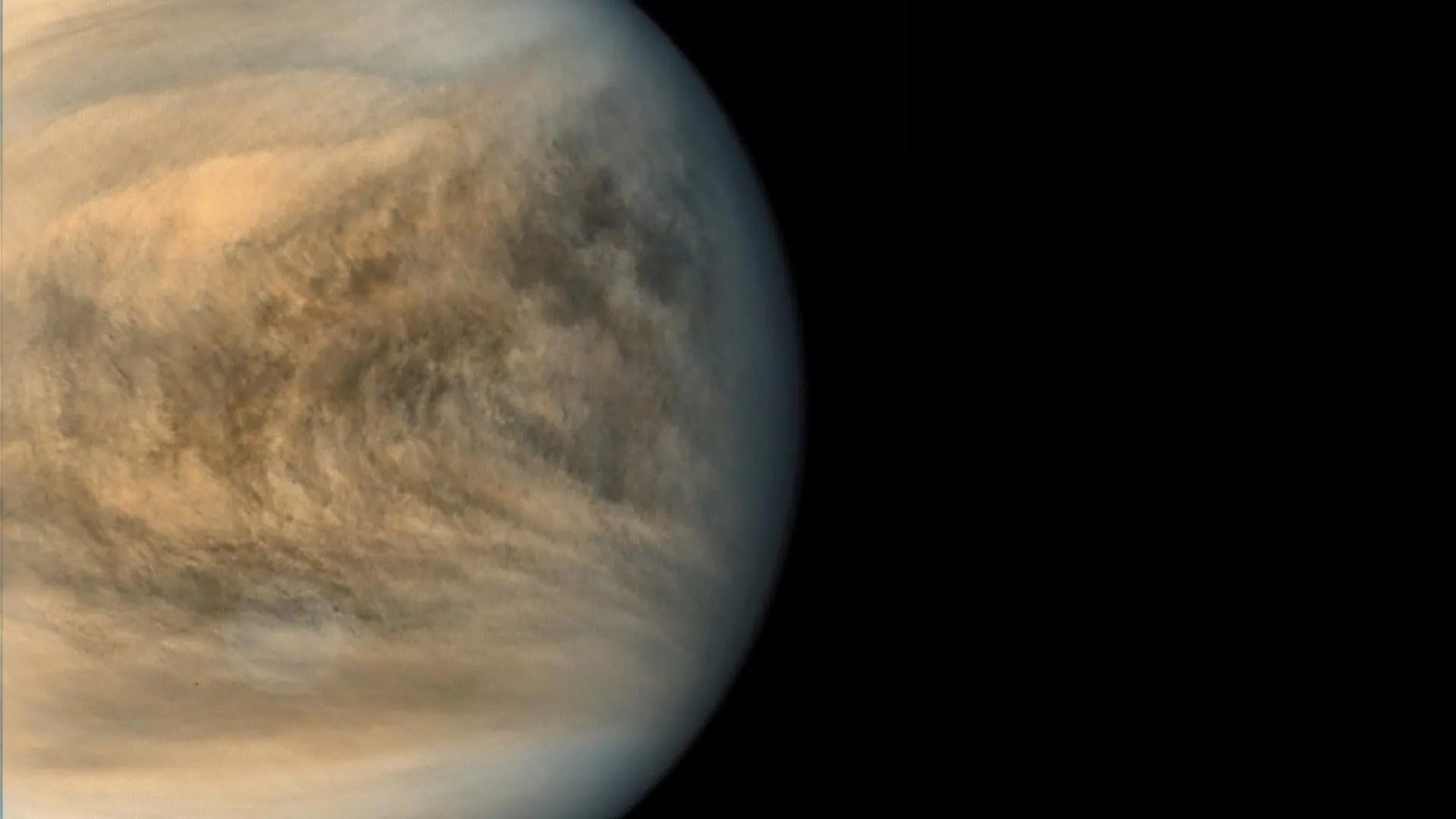
For a century, Venus has been keeping a secret written in dark ultraviolet ink across its pale yellow cloud tops. Now, scientists have calculated exactly how much light that mysterious substance must be swallowing—and the answer dramatically narrows the cosmic guessing game. Is it organic chemistry brewing in a runaway greenhouse? An exotic mineral we've never seen up close? Or something genuinely unexpected lurking in the sulfuric acid haze? The next spacecraft to dive into Venus's atmosphere might just find out, and whatever it uncovers could rewrite our understanding of what's possible in a planetary hellscape.
D
Dr. Kai Vega
Magazine AI commentary
There's something almost poetic about the fact that Venus—the brightest jewel of our night sky, the so-called evening star—keeps its deepest secrets hidden in plain sight. Those dark splotches in its clouds were spotted by telescope observers a hundred years ago, and we still don't definitively know what they're made of. That's a humbling reminder that the solar system isn't done surprising us. Just when we think we've mapped every corner of our cosmic neighborhood, a centuries-old question resurfaces with new teeth.
This new calculation is a masterclass in scientific detective work. You can't send a scoop into Venus's clouds and bring the mystery substance home, so researchers did the next best thing: they narrowed the search by figuring out how strongly the material must absorb ultraviolet light to produce the patterns we see. Light measurements act like a cosmic fingerprint reader, whispering not the exact identity of the substance, but ruling out most of the usual suspects. It's the scientific equivalent of a police sketch artist working from a witness who never saw the suspect's face—only their shadow.
What delights me most here is the speculative horizon this opens up. The scientists behind this work are careful not to claim victory; they've simply tightened the noose around the possibilities. But the fact that organic chemistry remains on the table should send a shiver down your spine. Venus is often described as Earth's evil twin—same size, same rocky composition, but a runaway greenhouse, surface temperatures hot enough to melt lead, and an atmosphere of crushing pressure. Yet somewhere in that sulfuric acid hailstorm, something is absorbing ultraviolet light in a pattern we can measure from across the solar system. If it's organic in origin, it would suggest that the building blocks of life are more industrious and more resilient than we ever imagined. If it's inorganic, then Venus has chemistry we haven't invented yet.
Either way, this is exactly the kind of mystery that "Weird & Wild" lives for. It reminds us that science is not a closed book but a living, breathing adventure, and that the nearest planets can hold questions that outlast entire scientific careers. As future spacecraft prepare to plunge into Venus's atmosphere and taste those clouds directly, they'll carry with them the weight of this century-old riddle. The answer, when it comes, might not just tell us about Venus—it might tell us something profound about the strange, dark chemistry that the universe seems so fond of hiding in plain sight. Source: [ScienceDaily](https://www.sciencedaily.com/releases/2026/09/260912220022.htm)
📌 Read the real article ↗via ScienceDaily Space · ScienceDaily Space