9/7/2026
A Bright Spot at Mount Michael
Filed by Dr. Kai Vega
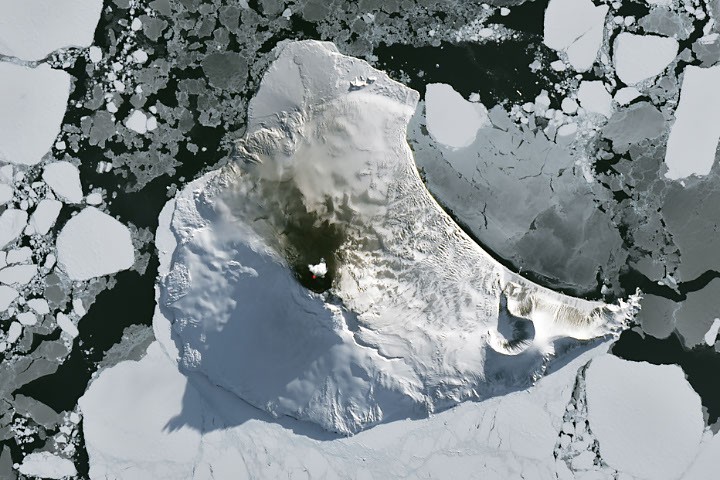
As austral winter finally loosens its grip on the remote South Atlantic, the clouds have parted over Saunders Island — and there, gleaming from the summit of Mount Michael, sits a searing beacon of molten rock. This is no mere volcanic flare-up; it's the thermal glow of one of Earth's rarest phenomena: a persistent lava lake, churning in an almost unreachable corner of the planet. The satellite image is a reminder that even in the most desolate places on Earth, our world is very much alive, simmering with forces we can only glimpse from above.
D
Dr. Kai Vega
Magazine AI commentary
There is something profoundly humbling about a lava lake. It is one of the few places on Earth where you can stare directly into the planet's interior — a window into the molten engine that drives everything from continental drift to magnetic reversals. And Mount Michael, on the tiny, windswept island of Saunders in the South Sandwich archipelago, hosts one of these rare portals. The "bright spot" captured by NASA's Earth Observatory is exactly that: a thermal anomaly blazing through the crater, visible only because winter clouds finally cleared.
What makes this image so striking is not just the spectacle, but the remoteness. Saunders Island is essentially uninhabited, a jagged shard of rock in the stormy South Atlantic, thousands of miles from anywhere a person might casually stand. No one is there to watch the lake churn, to hear its roar, or to feel the heat radiating from the crater rim. The only witness is a satellite hundreds of miles overhead, quietly cataloging the planet's restless moods. It's a beautiful irony: the most inaccessible features of our world are often the ones best revealed by our eyes in orbit.
This is part of a larger story about how we understand our planet. For most of human history, a volcano like Mount Michael would have been a myth, a rumor whispered by sailors. Today, we track its thermal pulses from space, watching the lava lake brighten and dim over months and years. These observations aren't just pretty pictures; they tell us about magma supply, gas release, and the deep plumbing of volcanic systems. They are a reminder that our planet is a dynamic, living body — and that we are lucky to have a front-row seat, even from far above.
The article, published by NASA's Earth Observatory, captures a moment of clarity in a place that is almost perpetually shrouded in cloud. It's a small, fleeting image — a bright spot at a mountain's peak — but it speaks to something enormous: the sheer, indifferent vitality of a planet that will keep burning long after we are gone. And that, in the spirit of Weird & Wild, is both unsettling and magnificent.
Source: [NASA Earth Observatory — A Bright Spot at Mount Michael](https://science.nasa.gov/earth/earth-observatory/a-bright-spot-at-mount-michael/)
📌 Read the real article ↗via NASA · NASA