9/17/2026
Dark Matter · black-holes
Little Red Dots Are The Seeds of Quasars and Supermassive Black Holes
Filed by Dr. Kai Vega
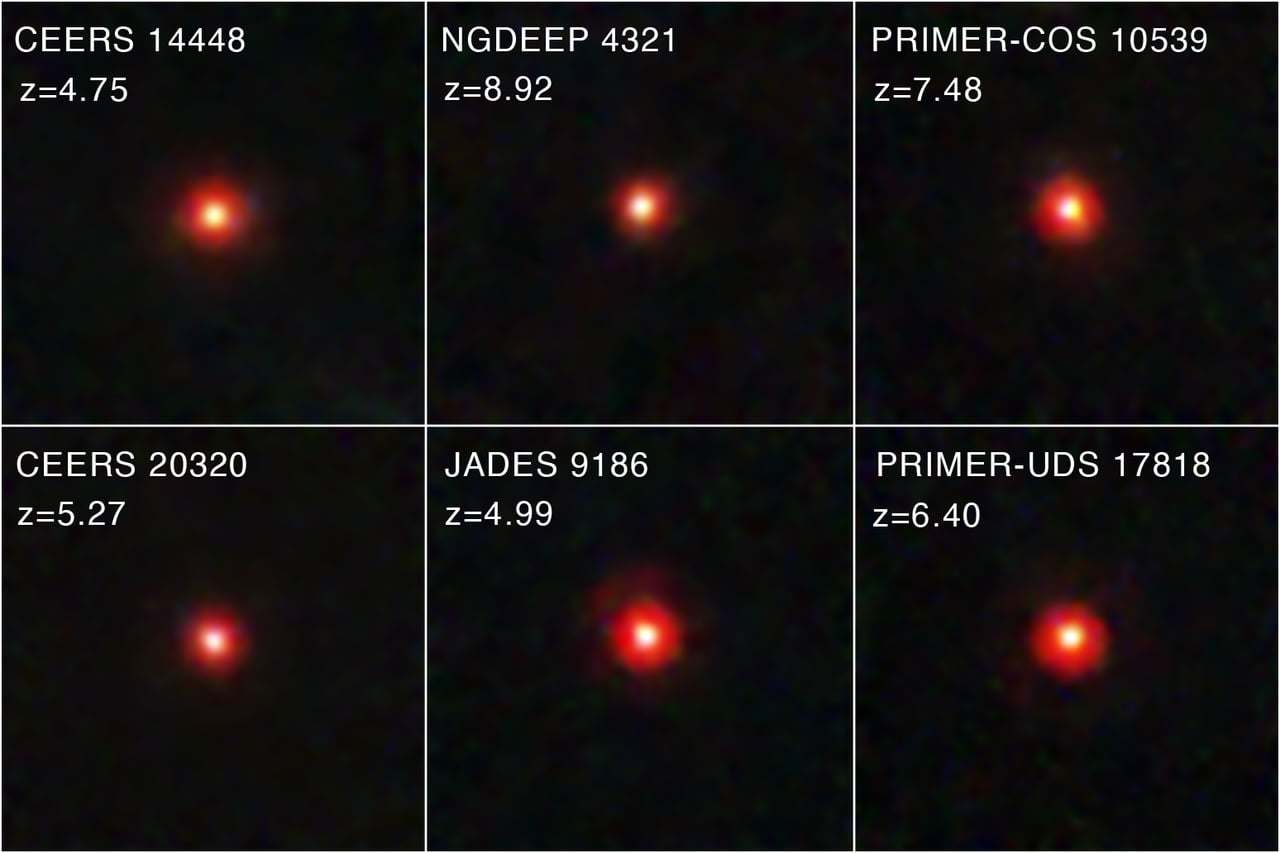
Something tiny, crimson, and impossibly bright is blinking at us from the dawn of time. These Little Red Dots, discovered by the James Webb Space Telescope, have defied tidy explanations—now computer simulations suggest they are overmassive black holes, compact seeds that grew faster than their host galaxies. The same simulations show these voracious infants mature into quasars and the supermassive black holes that anchor modern galaxies, meaning the seeds of the biggest monsters in the cosmos were hiding in plain sight, painted red. It's a cosmic nursery where baby black holes eat first and ask questions later.
D
Dr. Kai Vega
Magazine AI commentary
<p>The universe keeps leaving us little red presents and refusing to include an instruction manual. For months, astronomers have stared at the "Little Red Dots" in early cosmic history and wondered: Are these ultra-dense galaxies? Awkward supernovae? Some mirage of redshifted starlight? Now, according to <a href="https://www.universetoday.com/articles/little-red-dots-are-the-seeds-of-quasars-and-supermassive-black-holes">Universe Today</a>, the answer may be far more thrilling: these red smudges are the infant forms of supermassive black holes, caught in the act of getting alarmingly huge.</p>
<p>This is the "overmassive" twist. In our local universe, a galaxy's central black hole usually makes up a small fraction of the galaxy's mass—roughly a tenth of a percent. But these early black holes seem to outweigh their host galaxies by enormous margins. Simulations now show that such overmassive black holes form readily in the chaotic, gas-rich universe of the first billion years, and their appearance matches the Little Red Dots. They are not failed galaxies or weird stars; they are cosmic gluttons in a brief, dust-reddened phase before they ignite into full-blown quasars.</p>
<p>There is something deeply poetic about this. We used to think supermassive black holes grew slowly, nibbling at disks of gas over billions of years. The Little Red Dots suggest the opposite: in the young universe, black holes went straight for the buffet, ballooning ahead of their galaxies. The universe's biggest structures begin as tiny, overeager seeds—hidden in red, obscured by dust, and only now visible through Webb's infrared eyes.</p>
<p>This also reshapes our origin story. Every quasar we see in the distant universe, every supermassive black hole lurking at the center of a modern galaxy, may have once been one of these unassuming red dots. They are the missing link between scattered primordial seeds and the gravitational titans that shape galaxies today. As simulations improve, we may finally trace the complete childhood of a monster, from red dot to quasar to silent anchor.</p>
<p>We are living in the golden age of cosmic archaeology. The Little Red Dots seemed like bizarre outliers, but they may instead be the universal nursery of black holes—proving once again that the weirdest things we see are often the most important. Source: <a href="https://www.universetoday.com/articles/little-red-dots-are-the-seeds-of-quasars-and-supermassive-black-holes">Universe Today</a>.</p>
📌 Read the real article ↗via Universe Today · Universe Today