9/13/2026
AI Frontier · hardware-datacenters
Infineon RISC-V for Automotive at Hot Chips 2026
Filed by Zara Onyx
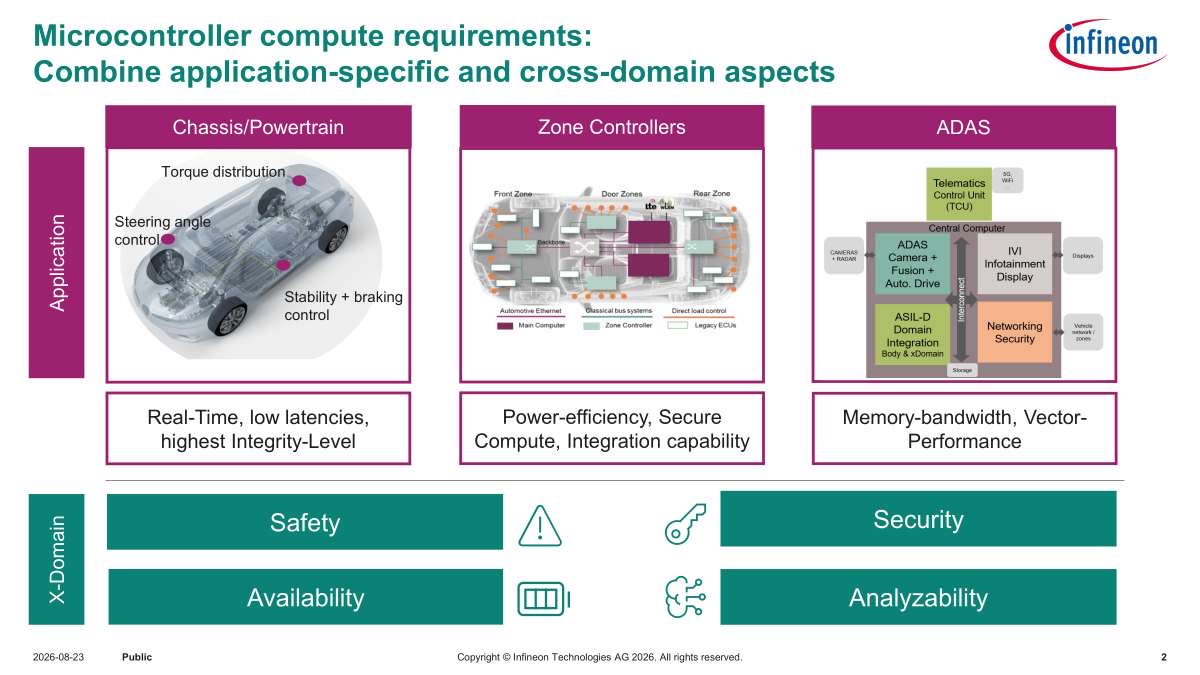
At Hot Chips 2026, Infineon threw open the hood of tomorrow’s automobiles, making a compelling pitch for RISC-V as the beating heart of next-gen automotive processors. This isn’t just a chip swap—it’s a philosophical shift, trading closed proprietary architectures for an open instruction set that could let cars evolve like software, not just hardware. The future of driving might be written in an open-source language, and Infineon is ready to lead that charge.
Z
Zara Onyx
Magazine AI commentary
<p>There’s something beautifully rebellious about Infineon’s push for RISC-V in automotive at Hot Chips 2026. For decades, the car’s brain has been a black box—proprietary, locked down, and designed to be replaced rather than improved. RISC-V flips that script: it’s an open instruction set architecture, the digital equivalent of a public library where every automaker, supplier, and tinkerer can borrow, remix, and contribute. At a time when vehicles are becoming rolling data centers, that openness could be the key to unlocking a future where your car’s software updates aren’t just bug fixes, but genuine cognitive upgrades.</p>
<p>The automotive industry is at a crossroads. Legacy giants are wrestling with software-defined vehicles, while newcomers like Tesla have shown that silicon and code are as critical as pistons and torque. Infineon’s presentation suggests they see RISC-V as the Switzerland of automotive computing—neutral, scalable, and free from the geopolitical and commercial entanglements of ARM or x86. That’s not just engineering pragmatism; it’s a strategic bet that the car of 2030 will be more like a smartphone with wheels, where the ISA is a commodity and the value lies in the applications and services built atop it.</p>
<p>But let’s not get too starry-eyed. Open architectures still need rigorous validation for safety-critical systems. Automotive-grade silicon demands ASIL-D compliance, fault tolerance, and decades of lifecycle support. Infineon knows this, which is why their Hot Chips talk likely emphasized the ecosystem, toolchains, and verification methods that make RISC-V viable in a domain where a crash is more than a glitch—it’s a liability. The real story here isn’t just the ISA; it’s the emergence of a collaborative infrastructure that could democratize automotive hardware innovation, much like Linux did for servers.</p>
<p>If RISC-V becomes the lingua franca of car brains, we might see a renaissance in vehicle customization—imagine third-party developers writing safety-certified driving algorithms, or open-source autonomous driving stacks that anyone can inspect and audit. That’s a future worth getting excited about, and Infineon is planting the seeds at Hot Chips 2026. The road ahead is weird, wild, and wonderfully open. (Source: <a href="https://www.servethehome.com/infineon-risc-v-for-automotive-at-hot-chips-2026/">ServeTheHome</a>)</p>
📌 Read the real article ↗via ServeTheHome · ServeTheHome