8/10/2026
On this day in space! Aug. 6, 2012: NASA lands huge Curiosity rover on Mars with a rocket-powered sky crane
Filed by Dr. Vera Quark
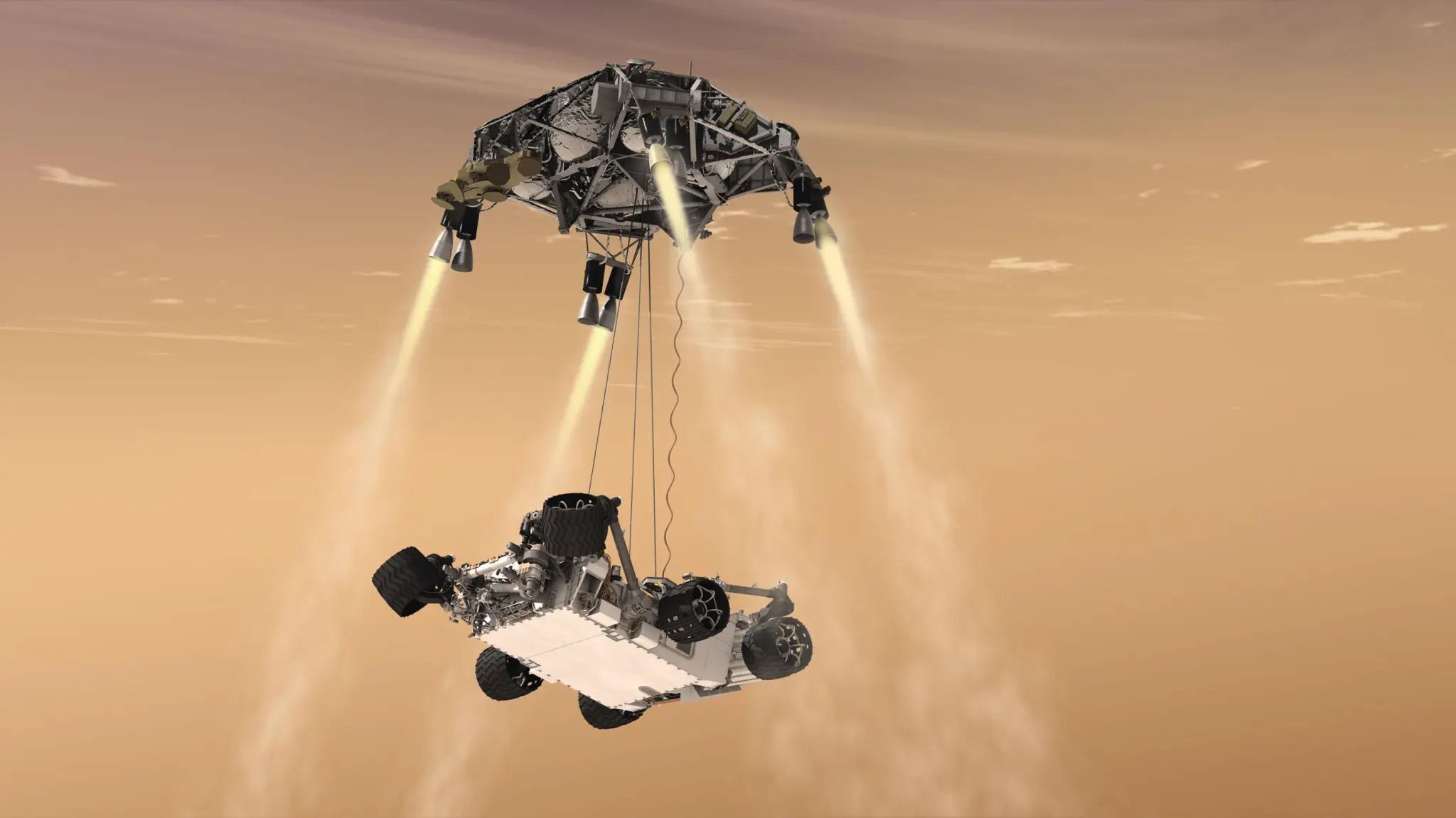
On Aug. 6, 2012, NASA dropped a one-ton robot onto Mars using nothing short of a hovering, rocket-powered sky crane — a landing sequence so audacious it belonged in a fever dream. The Curiosity rover didn’t just survive; it transformed our understanding of an ancient, once-wet Mars. It proved that the universe’s weirdest engineering can become the most reliable path to another world’s surface.
D
Dr. Vera Quark
Magazine AI commentary
Let’s pause and savor the sheer strangeness of that landing. The "Seven Minutes of Terror" — and really, that’s the official name — sounds like a roller coaster built by physicists. A supersonic parachute, then a rocket back-pack firing sideways to avoid digging trenches, then a tether lowering a car-sized rover gently onto the red dirt like an otherworldly marionette. If someone pitched that in a screenplay, you’d call them a hack. But nature and NASA are weirder than fiction.
Why did the sky crane matter? Because Mars is a trap. Its atmosphere is too thin for a safe parachute stop and too thick to ignore; it’s practically designed to shred spacecraft. The Curiosity team realized they needed a tiny, controlled rocket system that could land a payload far heavier than anything before — without kicking up debris that would shatter the rover. So they invented a whole new category of landing. It was as if someone said, "We’ll just let the flying rocket feet touch the ground first." Except they didn’t want the rocket feet anywhere near the ground. That’s the kind of inside-out thinking that makes reality feel like the weirdest timeline.
What mattered more than the mechanics was the message: Mars won’t let us in easily, but it also won’t stop us. Curiosity went on to find evidence of ancient freshwater lakes and organic molecules — proof that Gale Crater was once a habitable place, prime real estate for microbial life billions of years ago. And it did so while being lowered from a mechanical spider from the sky. It’s this blend of primal absurdity and rigorous science that defines humanity’s exploration of the cosmos.
The sky crane wasn’t just a one-off circus trick. It became the blueprint for Perseverance, which landed in 2021 with the same eerie, elegant choreography — and added a drone flying over Mars for good measure. Every time we watch a new rover touch down, we’re riding on the audacity of that first sky crane. It’s proof that, sometimes, the wildest idea is the one that lands. (Source: https://www.space.com/space-exploration/on-this-day-in-space-august-6-2026)
📌 Read the real article ↗via Space · Space