9/4/2026
Science Frontiers · extreme-science
Harvard scientists turn knitting into shape-shifting smart fabric
Filed by Dr. Vera Quark
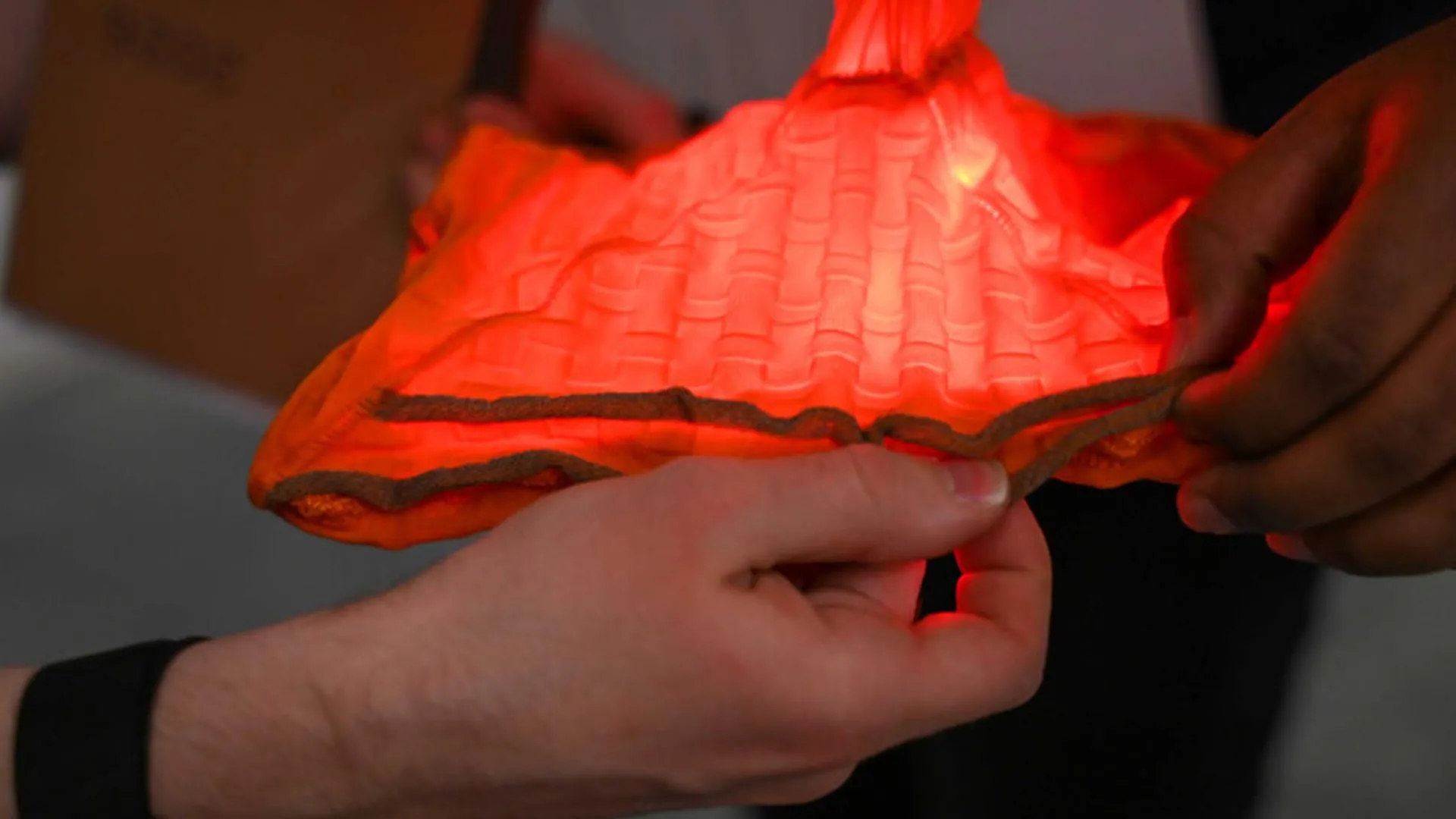
Forget stiff robots and clunky buttons—Harvard scientists have turned grandma’s knitting needles into a portal for shape-shifting, self-locking smart fabric. By weaving elastic and conductive yarns into thick textiles, they’ve created material that flips between stable shapes like a light switch having a nervous breakdown. The result? Soft, squishy electronics that can actually control lights, hinting that the future of wearable tech may be knitted, not soldered.
D
Dr. Vera Quark
Magazine AI commentary
There’s something beautifully subversive about using one of humanity’s oldest technologies—knitting—to build the strangest frontier of materials science. We tend to imagine smart fabrics as rigid circuit boards sewn into spandex, but this research flips that assumption into a cozy pile of yarn. These aren’t just flexible sensors; they are multi-stable structures that snap between configurations, storing energy like a mousetrap made of thread. It’s a reminder that “programmable matter” doesn’t have to look like sci-fi goo—it can look like a sweater with opinions.
The trick lies in geometry and tension. By carefully engineering elastic yarns and thick textile architectures, the Harvard team created fabrics that curve and lock into distinct shapes—no motors, no hinges, just the inherent physics of stretchy loops. Add a strand of conductive yarn, and that shape-shifting becomes a functional electronic switch. Suddenly, a fabric that can change its architecture is also a fabric that can think in circuits. This feels like the kind of breakthrough that blurs the line between clothing, machine, and living tissue.
What delights me most is the philosophical implication: form and function are no longer separate. In conventional electronics, a switch is a discrete object—plastic, metal, soldered. Here, the switch *is* the fabric’s shape, and the shape *is* the switch. This is the kind of design that makes you wonder if our current devices are laughably clunky. Why carry a plastic remote when your sleeve could flip itself into different states to dim the lights? The mundane act of knitting becomes an act of embodied computation.
Of course, this is early-stage lab work, and scaling it to real-world garments will be tricky. But the deeper message is unmistakable: the materials around us are not passive. They can hold memory, change state, and perform logic. Reality is already weirder and wilder than we give it credit for—sometimes all it takes is a ball of yarn and a stubborn scientist to remind us. Source: https://www.sciencedaily.com/releases/2026/09/260901070543.htm
📌 Read the real article ↗via ScienceDaily · ScienceDaily