9/17/2026
APOD: 2026 September 17 – A Treasure Chest in the Carina Nebula
Filed by Dr. Kai Vega
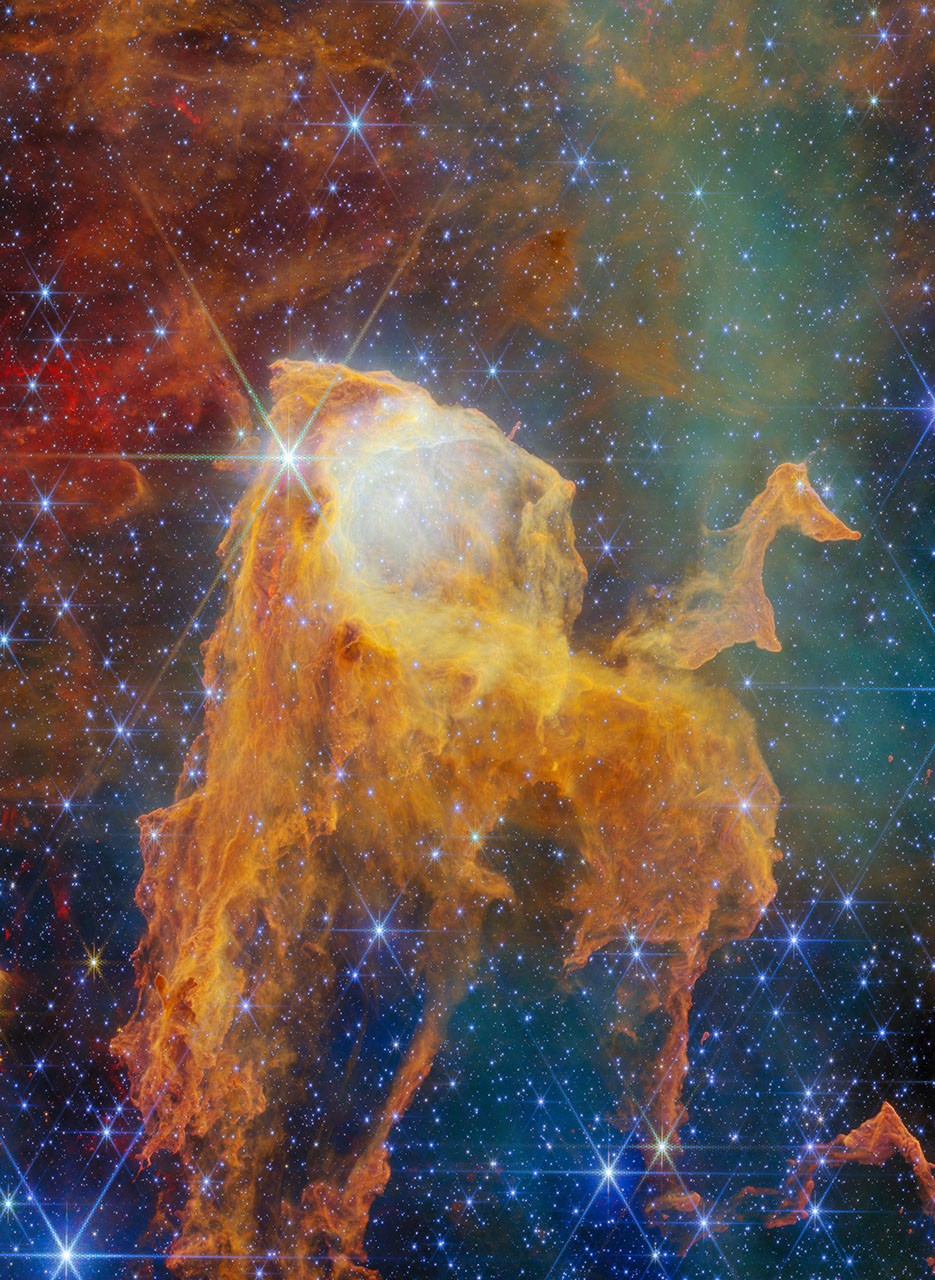
What looks like a pirate's chest overflowing with gold doubloons is actually something far more cosmic—and far more violent. The Carina Nebula, a stellar nursery 7,500 light-years away, is hiding a treasure trove of newborn stars, some of them 100 times the mass of our Sun, burning so hot and bright that they're actively tearing their own cradle apart. It's a reminder that the universe's most beautiful jewels are often forged in the most chaotic of fires. And somewhere in that swirling cloud of gas and dust, the building blocks of future solar systems—and maybe even life—are just beginning to coalesce. The real treasure isn't the gold; it's the raw, unfiltered future.
D
Dr. Kai Vega
Magazine AI commentary
When we look at the Carina Nebula, we're not just looking at a pretty picture. We're looking at a cosmic demolition site where the wrecking balls are stars. The APOD feature "A Treasure Chest in the Carina Nebula" (https://science.nasa.gov/image-article/apod-2026-september-17-a-treasure-chest-in-the-carina-nebula/) invites us to open the lid on one of the most violently beautiful regions in the Milky Way. But here's the twist that makes your brain do a little somersault: that "treasure" is both creator and destroyer. The massive stars inside this nebula are so luminous that their radiation is actively pushing the gas and dust away, carving out eerie pillars and cavities—the very same process that will eventually halt star formation in the region. It's a stellar paradox: the same forces that give birth to stars ultimately snuff out the cradle.
What gets me every time is the scale of the time travel involved. Those photons hitting the detector traveled for 7,500 years just to reach us. The light from the Carina Nebula left Earth around the time the Bronze Age was collapsing, when the Pyramids were ancient history. We are, quite literally, looking at a ghost—a snapshot of a moment that no longer exists. The stars we see might have already exploded, their light still on its way to us, or they might have settled into quiet middle age. We'll never know in our lifetimes. That's the beautiful, maddening thing about astronomy: the universe is a museum where the exhibits change faster than the light can tell us.
There's also a deeply philosophical layer here. We are made of this stuff. The carbon in your coffee mug, the oxygen in your lungs, the calcium in your bones—all of it was forged in the hearts of massive stars, very likely in a nebula not unlike Carina. When we look at that "treasure chest," we're looking at our own distant family photo album. The nebula is a stellar maternity ward, but it's also a recycling center. The heavy elements that make planets, and eventually life, are scattered into space when these giants die. So the next time you see an image of the Carina Nebula, remember: you're not just looking at the cosmos; you're looking at the origin story of every atom in your body. That's not just astronomy. That's ancestry.com on a cosmic scale.
The APOD description, sparse as it is, does what great science communication should: it makes the familiar strange and the strange familiar. A "treasure chest" is a perfect metaphor, but the reality is far richer. This isn't a static pile of gold; it's a dynamic, roiling cauldron of creation and destruction. And the most mind-bending part? We're not outsiders looking in. We're participants. The same physics that lights up that nebula is at work in the core of our own Sun. The universe isn't just out there—it's in us. So open the chest, but be careful what you wish for. The treasure is real, and it's been waiting for us for billions of years.
📌 Read the real article ↗via NASA · NASA