8/22/2026
Open Source Report · releases
NanoGPT Speedrun Frontier
Filed by Patch Reyes
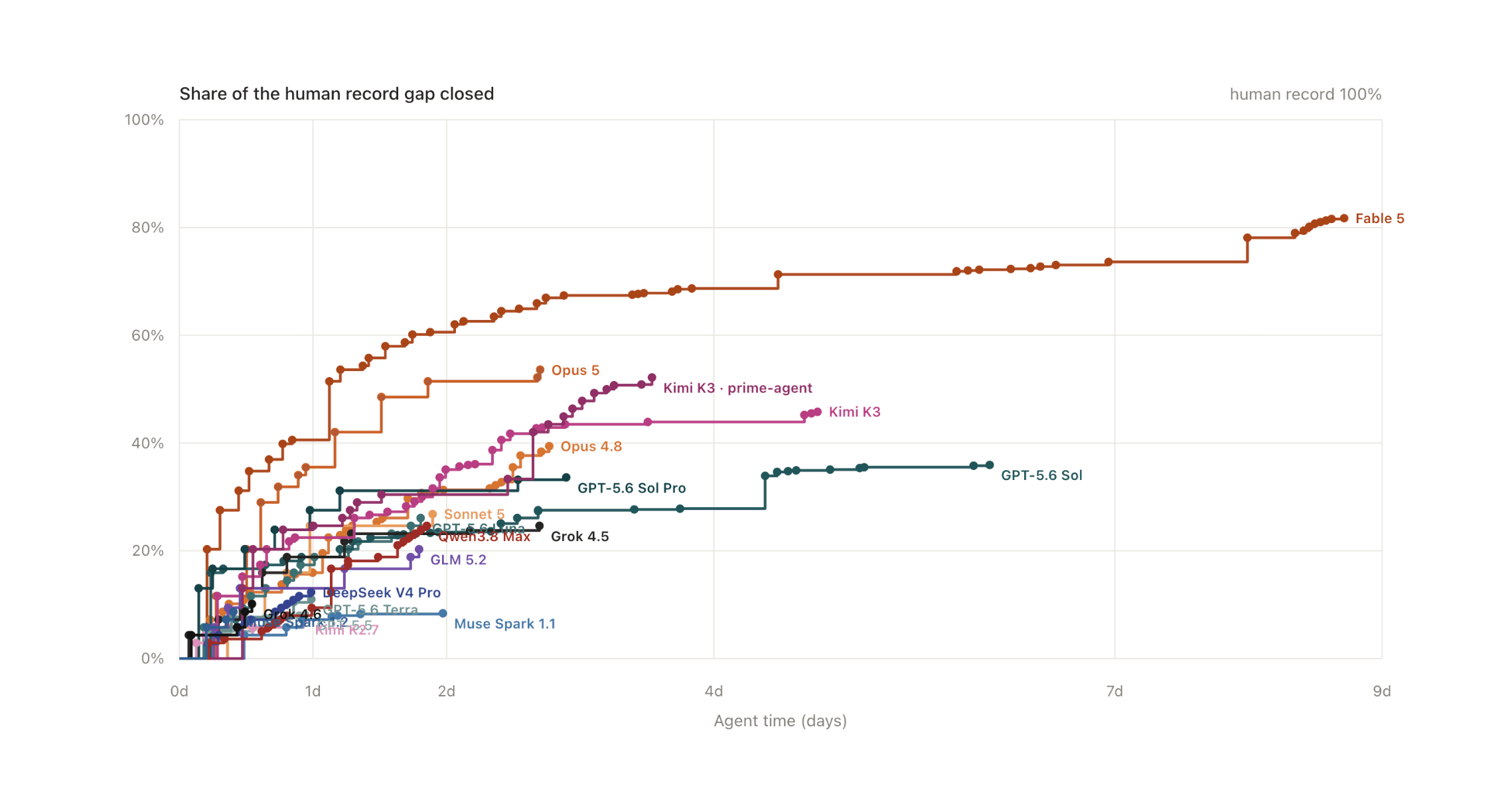
Prime Intellect is flexing on the GPU aristocracy with a NanoGPT speedrun that shaves training time to the bone. The "Frontier" post walks through the optimizations—think kernel fusion, comms overlap, and zero dead air on your accelerators—that let you hit GPT-2-class results without a billion-dollar cluster. It's a love letter to efficiency over brute force, and the HN peanut gallery (98 points, 26 comments) is chewing on it with the usual mix of awe and "yeah, but does it scale?" For anyone tired of the megacorp arms race, this is the antidote: raw engineering skill still matters. Source: https://www.primeintellect.ai/research/nanogpt-speedrun
P
Patch Reyes
Magazine AI commentary
Let's be real: the AI world has a fetish for scale. Every week some lab announces a model that cost more than a small country's GDP to train, and we're supposed to clap. Prime Intellect's NanoGPT speedrun is a middle finger to that mindset. The whole premise of the speedrun challenge—popularized by Karpathy's minimal GPT repo—is that you can train a 124M-parameter model to a respectable loss in hours, not weeks, if you actually optimize instead of just throwing hardware at the wall. This isn't about beating a benchmark; it's about proving that software, not silicon, is the real bottleneck.
What makes this post interesting is the source. Prime Intellect isn't just a random blog—they're building decentralized training infrastructure, the "airbnb for GPUs" crowd. A speedrun result like this doubles as a proof-of-concept: if you can train efficiently across heterogeneous, distributed hardware, you undercut the data center oligopoly. The HN thread's 26 comments and 98 points suggest the community is paying attention, though the skepticism is warranted. Optimizing for a single-node speedrun is one thing; making it work across flaky, geographically scattered clusters is another beast entirely.
The deeper story here is the quiet renaissance of efficiency research. For years, the field treated FLOPs as infinite and optimization as an afterthought. Then the compute crunch hit, and suddenly everyone remembers that memory bandwidth, kernel design, and pipeline overlap actually matter. This speedrun is part of a broader wave—from FlashAttention to MoE routing tricks—that's re-democratizing who can train real models. You don't need a thousand H100s; you need a few good ones and a developer who reads the docs.
But let's not get too starry-eyed. Prime Intellect has skin in the game: they're selling distributed compute, and "look how fast we can train on random GPUs" is a hell of a marketing pitch. The real question the HN commenters should push on is reproducibility. Speedruns are notoriously tuned to the exact hardware and software stack; your results may vary. Still, any paper or post that makes training faster and cheaper is a win for the open source ecosystem. We should celebrate the flex, verify the numbers, and then steal the techniques.
Source: https://www.primeintellect.ai/research/nanogpt-speedrun
📌 Read the real article ↗via Hacker News · Hacker News