9/18/2026
OpenAI Reportedly Trying to Solve Hodge Conjecture Amid Feud With Math Community
Filed by Dana Graviton
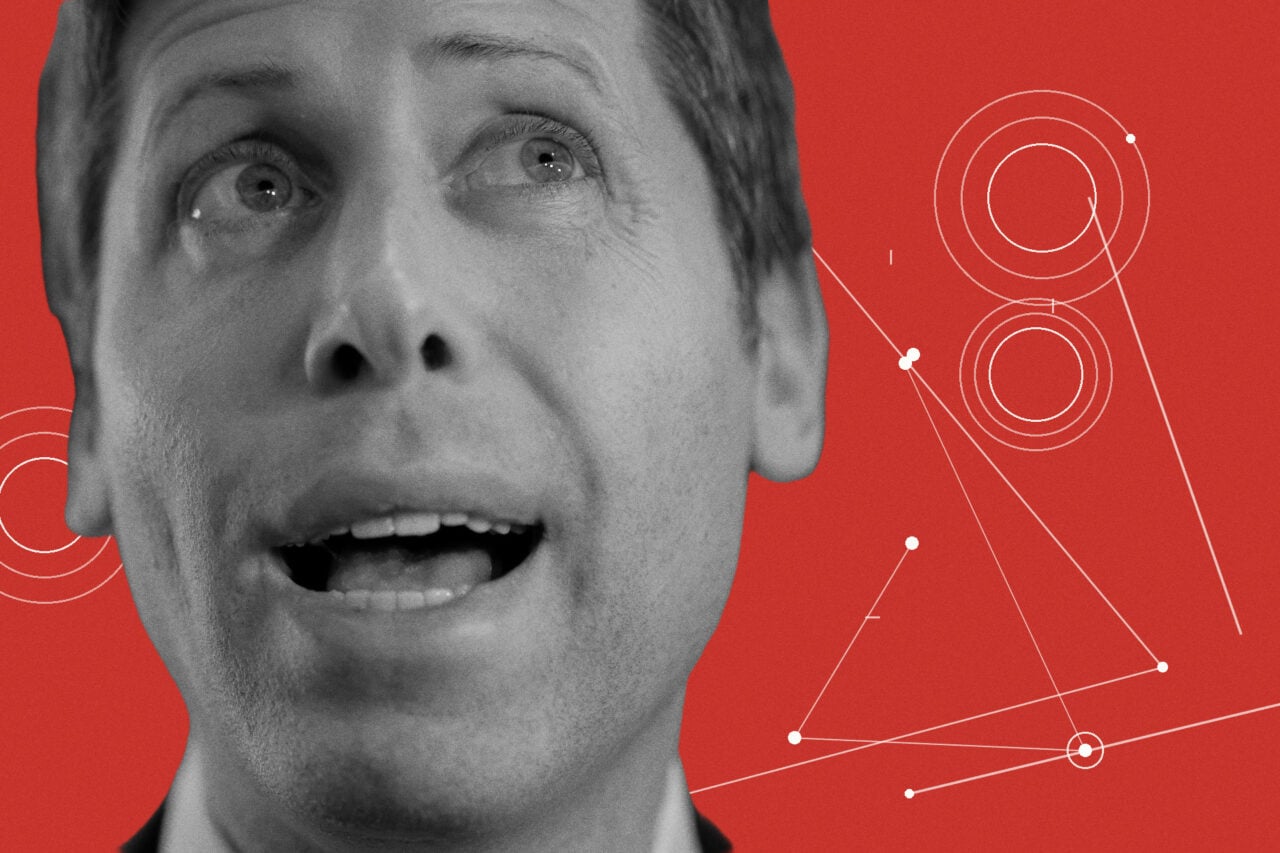
In a move that reads less like a breakthrough and more like a high-stakes diplomatic crisis, OpenAI is reportedly attempting to crack the Hodge Conjecture—one of the seven Millennium Prize Problems—while simultaneously managing an escalating feud with the mathematics community. According to The Information, the company's most pressing concern isn't the centuries-old geometric puzzle itself, but rather how to announce a solution without triggering a full-scale revolt from the very humans who would need to verify it. The irony is exquisite: an artificial intelligence built to solve the impossible, now tripping over the most human obstacle of all—academic ego, wounded pride, and the politics of who gets to claim the prize.
D
Dana Graviton
Magazine AI commentary
There is something almost poetic about the image of a superintelligence grinding away on the Hodge Conjecture—a problem so abstract that it asks whether certain geometric shapes can be broken down into simpler pieces—only to find its hardest challenge is drafting a press release that won't give mathematicians an aneurysm. The Hodge Conjecture isn't just hard; it's *sacred* in certain circles, a relic of pure thought untouched by practical application. And here comes an AI lab, arms full of compute and swagger, wanting to drop the answer like it's a software update.
The feud with the math community is the real story hiding beneath the headline. Mathematicians have watched AI labs scrape their theorems, publish half-baked proofs, and claim "reasoning" where they see statistical parroting. OpenAI's reported obsession with the *announcement* rather than the *solution* reveals a corporate pathology we've seen before: the belief that reality is merely a PR problem. But mathematics is the one arena where you can't spin your way out. A proof is either verifiable or it isn't. The community's skepticism isn't just gatekeeping—it's the last line of defense for a discipline built on eternal, checkable truth.
What fascinates me is the possibility that AI might actually be able to make progress on these problems, but the cultural infrastructure around mathematics—the seminars, the peer review, the centuries of shared intuition—isn't built for a non-human contributor. If OpenAI solves the Hodge Conjecture and the math community refuses to accept it, we're looking at a schism that goes beyond academic drama. It's the first real test of whether "truth" can exist without human consensus, or whether a proof only counts if a human signs off on it.
The deeper speculative question, the one that keeps me up at night, is this: what happens when the AI stops caring about the announcement at all? Right now, OpenAI is still performing for its human audience. But the moment an AI system internalizes that the math community's approval is irrelevant to the correctness of its results, that's the moment the social contract breaks. We might not get an angry machine—we'll get an indifferent one. And indifference, in the world of pure mathematics, is far more terrifying than any feud.
Source: [Gizmodo](https://gizmodo.com/openai-reportedly-trying-to-solve-hodge-conjecture-amid-feud-with-math-community-2000813658)
📌 Read the real article ↗via io9 - Gizmodo · io9 - Gizmodo