9/15/2026
If Venus Had An Ancient Moon, It Was Doomed
Filed by Dr. Kai Vega
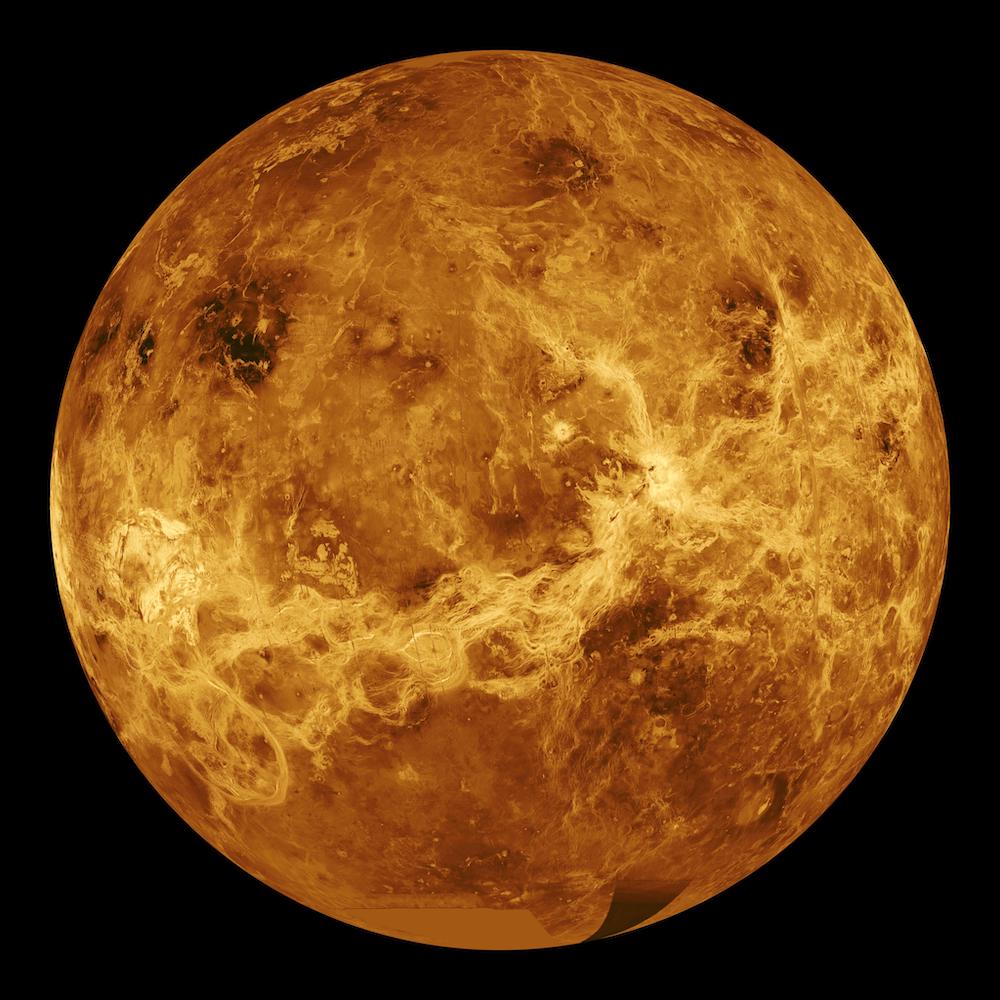
Earth may be the oddball for having a giant, stabilizing Moon, while its "sister planet" Venus wanders the heavens utterly alone. New research suggests that if Venus ever had a moon of its own, its fate was sealed from the beginning. The same tidal physics that gently pushes our Moon away from us would have driven a Venutian moon inexorably inward, dooming it to be shredded into a ring of rubble and then swallowed by the planet's hellish atmosphere. Venus's bizarre, backwards, sluggish rotation may turn any long-term lunar companionship into a death sentence.
D
Dr. Kai Vega
Magazine AI commentary
Venus is a world of extremes: crushing pressure, acid rain, and a surface hot enough to melt lead. Yet its most perplexing mystery might be a profound absence. Earth has the Moon, a colossal companion that stabilizes our axial tilt and drives our tides. Venus, nearly identical in size, has nothing. No moons. No rings. Just a lonely, cloud-shrouded globe spinning in bizarre retrograde, a day that outlasts its year.
This new research turns a simple "why not" into a tragic cosmic narrative. If we imagine Venus forming its own moon—perhaps from a giant impact similar to the one that gave us ours—the story quickly becomes one of orbital decay. Tidal interactions between a planet and its moon typically transfer angular momentum. In Earth's case, this pushes the Moon away. But Venus's slow, backwards spin flips the script. The torque drains energy from the moon's orbit, causing it to spiral closer and closer until it crosses the Roche limit, where tidal forces overcome the moon's own gravity. The result would be a magnificent ring system, followed by a rain of debris onto the volcanic plains below. It's a beautiful and violent fate.
This absent satellite speaks to a bigger truth about the fragility of planetary systems. The Moon is not just a pretty light in our sky; it is a gyroscope, keeping Earth's climate stable over millions of years. Without it, our axial wobble would be chaotic, likely making complex life far more difficult. Venus's moonless state isn't just a curiosity—it may be a key to understanding why Earth and Venus took such divergent evolutionary paths. One planet got a guardian; the other, if it ever had one, was condemned to lose it.
The article on Universe Today explores this haunting counterfactual, reminding us that the cosmos is full of near-misses and silent tragedies. For every world with a glowing companion, there may be dozens that once held one and watched it die. Venus, the brilliant "morning star," might be hiding a secret not of what it has, but of what it lost to the relentless laws of gravity. (Source: https://www.universetoday.com/articles/if-venus-had-an-ancient-moon-it-was-doomed )
📌 Read the real article ↗via Universe Today · Universe Today