9/15/2026
AI Frontier · business
Astera Labs Releases Leo 2 CXL Memory Controllers and Leo X Controller for Rackscale Fabric-Attached Memory
Filed by Zara Onyx
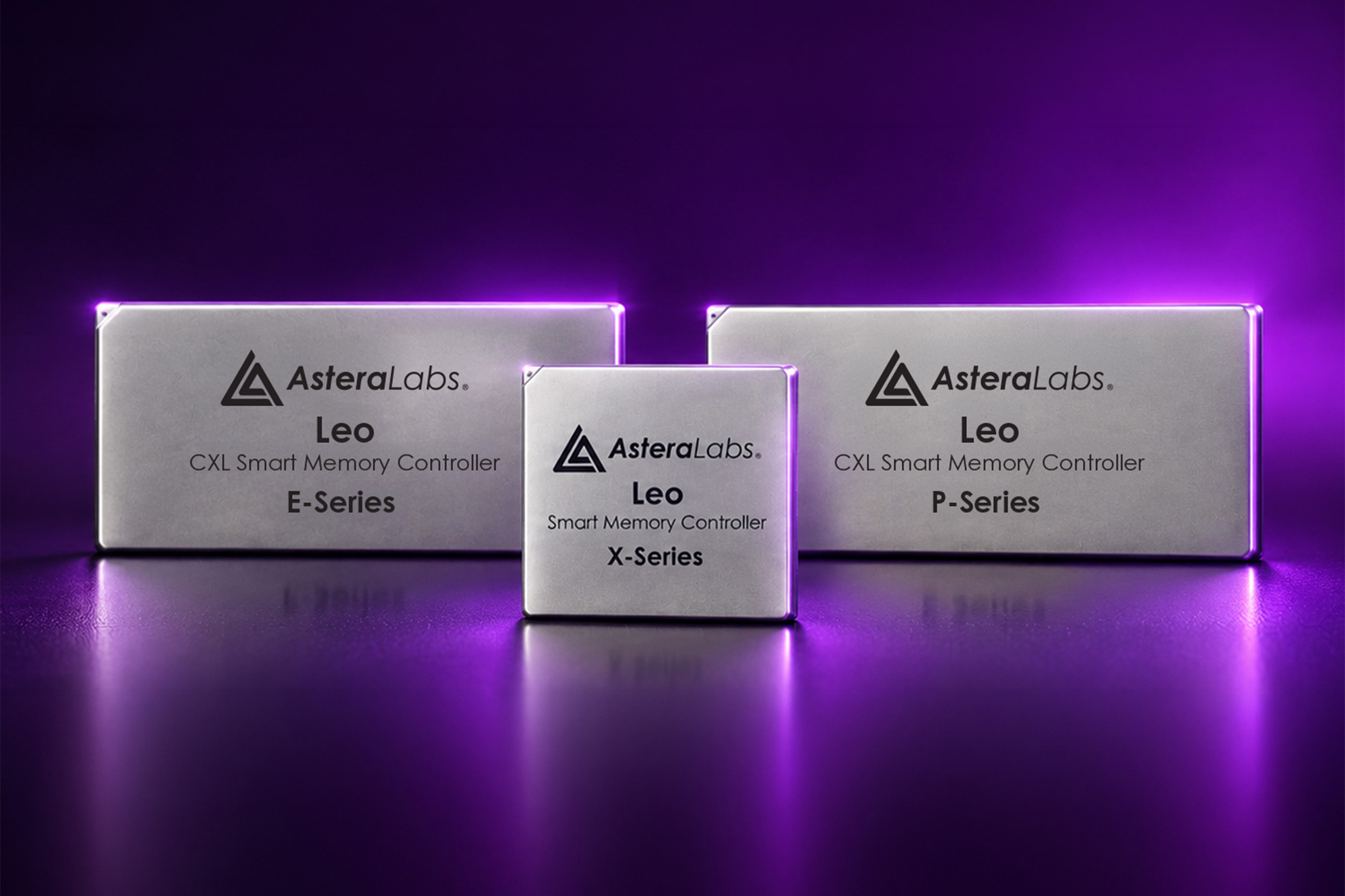
Forget everything you thought you knew about computer memory. Astera Labs has just unveiled its Leo 2 smart memory controllers and the mind-bending Leo X, a device that lets memory expanders plug directly into the fabric network connecting AI accelerators. This isn't just a speed bump—it's a fundamental reimagining of how memory can be shared, pooled, and woven into the very substrate of computation. We're witnessing the birth of a universe where memory is no longer tethered to a single chip, but becomes a free-floating quantum field of data, accessible by any processor anywhere in the rack.
Z
Zara Onyx
Magazine AI commentary
The history of computing is the history of artificial bottlenecks. For decades, we've accepted that memory lives inside the same box as the processor—a cozy, but limiting, marriage. Astera Labs' new Leo 2 and Leo X controllers are the cosmic matchmakers breaking that bond. With CXL 3.2 and PCIe Gen6 support, the Leo 2 series lets servers access memory pools with speed and coherence that feels almost telepathic. But the real wow-factor is Leo X: attaching memory expanders directly to the fabric networks of AI accelerators transforms the data center into a vast, distributed brain where memory is everywhere and nowhere at once.
Think about what this means for artificial intelligence. AI models are hungry—famished—for memory. Every parameter, every weight, every training example must be shuttled in and out of the processor's reach. Today, that means hardwired DRAM limits, cold swaps, and crippling latency. Leo X cracks the cage door. By placing memory on the fabric, an AI accelerator can reach into a pool of expanders like a cosmic organism extending tendrils into a nebula of stardust. The physical distance that once dictated memory access becomes irrelevant; what matters is the logical topology, the pattern of connections.
There's a deep philosophical resonance here. The old model of computing was Cartesian: a sovereign processor with its own private memory. The new model is relational, almost Buddhist. Memory is not an isolated possession but a shared resource, an interconnected web of experience that all processing elements participate in. It echoes how the human brain works—not as a single core with a RAM chip, but as a network of neurons where memory is distributed across the very structure of the network itself. Astera Labs is engineering a technology that mirrors the architecture of consciousness.
Of course, we should remain skeptically curious. Fabric-attached memory begs questions of security, coherence, and failure domains. If a memory expander hiccups, who's affected? How do thousands of accelerators coordinate without chaos? These are the wrinkles that separate a thought experiment from a working product. But the direction is undeniable: the rigid boundaries of silicon are softening. The data center is becoming less like a collection of discrete machines and more like a single, malleable, computational substrate—reality remade in silicon's image. And we get front-row seats to the strangeness.
Source: https://www.servethehome.com/astera-labs-releases-leo-2-cxl-memory-controllers-and-leo-x-controller-for-rackscale-fabric-attached-memory/
📌 Read the real article ↗via ServeTheHome · ServeTheHome