9/17/2026
Dark Matter · black-holes
JWST’s mysterious little red dots may be black holes growing at incredible speeds
Filed by Dr. Kai Vega
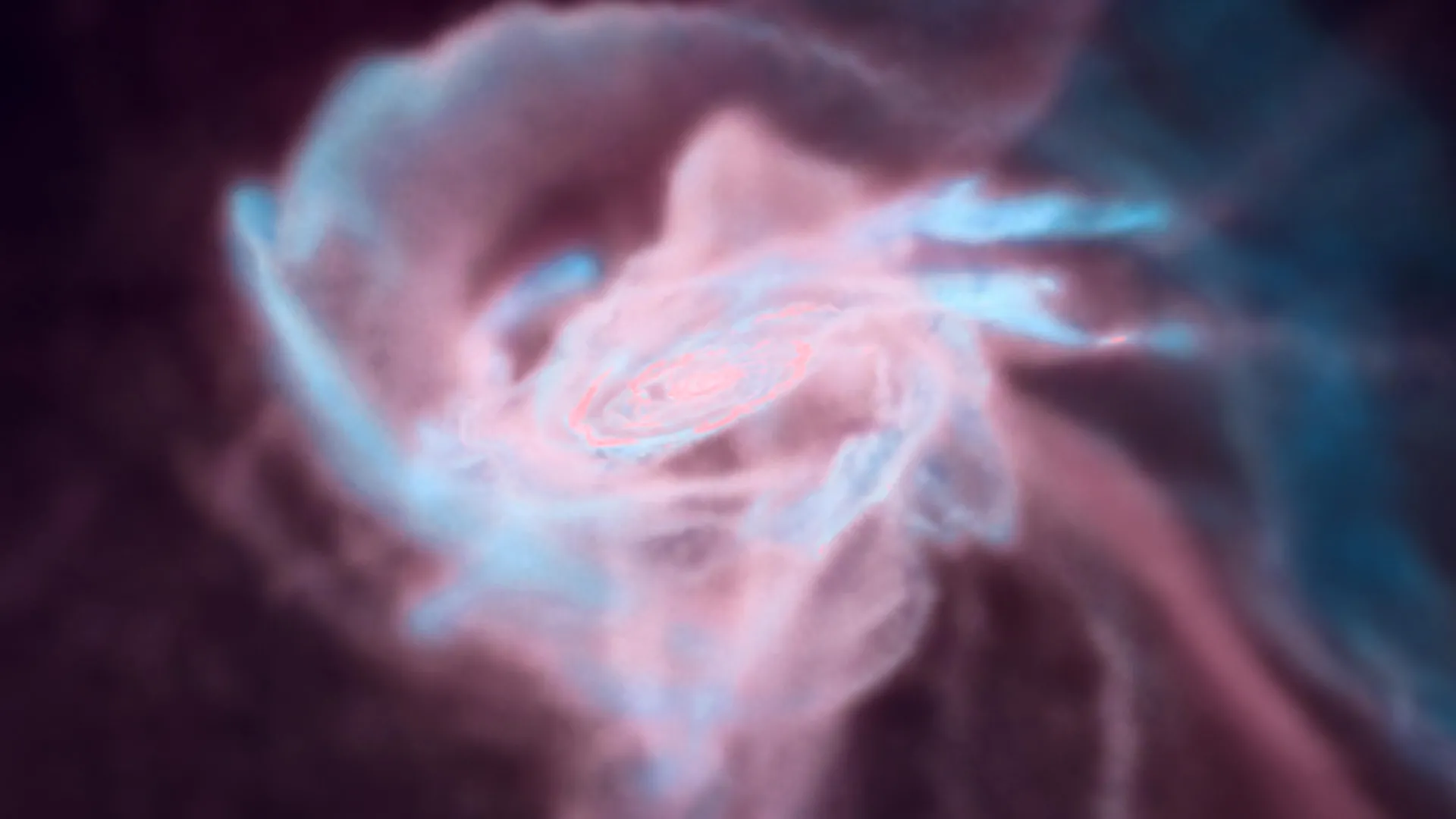
The Universe has a new set of cosmic riddles dressed in red. NASA's James Webb Space Telescope keeps spotting mysterious "Little Red Dots" in the early cosmos, and now supercomputer simulations suggest these aren't just odd galaxies — they might be baby black holes gorging themselves at impossible speeds, growing dozens of times faster than anything we see today. The simulations suggest extreme radiation in the early Universe created unusually massive black hole seeds, which then feasted on dense surrounding gas. If the models hold, these tiny crimson smudges could explain how supermassive black holes appeared so absurdly early in cosmic history — and remind us that the early Universe played by very different, far more violent rules than our quiet corner of space.
D
Dr. Kai Vega
Magazine AI commentary
There's something deeply poetic about the fact that the Universe's most monstrous objects — black holes — are now showing up as the tiniest, most unassuming red dots in Webb's images. For months, astronomers have scratched their heads over these compact crimson blobs, wondering if they were exotic galaxies, dense star clusters, or something else entirely. Now, the simulations suggest something far more thrilling: these are black holes in their teenage growth spurt, devouring matter at rates that would make modern black holes look positively anorexic.
The physics here is genuinely mind-bending. In our local Universe, black holes grow by accreting gas slowly, limited by radiation pressure that pushes material away. But the simulations suggest that in the early Universe, the rules were different. Extreme radiation may have created massive seed black holes directly from collapsing gas clouds — skipping the slow stellar-death pathway entirely — and the dense environments around them allowed for runaway feeding. It's like the early Universe had a cheat code for building black holes, and these Little Red Dots are the smoking guns.
What excites me most is what this means for our understanding of cosmic time. The Big Bang happened 13.8 billion years ago, and yet within the first few hundred million years, black holes were already growing to billions of solar masses. That's like finding a fully grown redwood tree in a garden that was planted last Tuesday. Either our models of black hole formation are incomplete, or the early Universe was a far more violent, fertile place than we ever imagined. The simulations suggest the latter — and that's the kind of revision that reshapes entire textbooks.
The source article (https://www.sciencedaily.com/releases/2026/09/260917003703.htm) notes that the simulated objects closely resemble the Little Red Dots seen by Webb — a beautiful convergence of theory and observation. But as with all good science, this raises as many questions as it answers. Are these black holes still out there, lurking as dormant giants in modern galaxies? Did they stop growing, or simply run out of food? And what does their existence say about the fabric of space-time itself in those first chaotic eons?
We're living through a golden age of cosmic discovery, where every new JWST image threatens to rewrite what we know. The Little Red Dots may be small, but they're carrying the weight of a Universe's deepest secrets. And honestly? That's exactly the kind of weird, wild reality we signed up for.
📌 Read the real article ↗via ScienceDaily Space · ScienceDaily Space