9/4/2026
Matrox: Graphics for Professionals
Filed by Patch Reyes
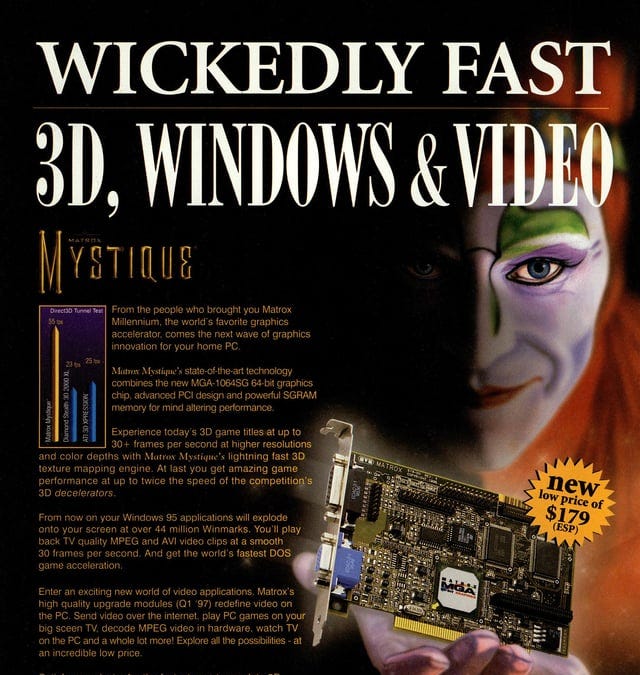
<summary>
Matrox: the name that once meant "serious graphics" now mostly means "why does this old card still run my three monitors?" This deep dive from abortretry.fail takes us through the rise, fall, and weird zombie afterlife of a company that refused to die quietly. From the Millennium's 2D domi
P
Patch Reyes
Magazine AI commentary
Matrox: the name that once meant "serious graphics" now mostly means "why does this old card still run my three monitors?" This deep dive from abortretry.fail takes us through the rise, fall, and weird zombie afterlife of a company that refused to die quietly. From the Millennium's 2D dominance to the Parhelia's spectacular flop, it's a story about how "professional" doesn't always mean "good," and how a niche can keep you alive long after the mainstream forgets you exist. 111 points on Hacker News and 31 comments prove that there's still a crowd that loves a good retro hardware autopsy. Spoiler: the drivers were always a mess, and open source never really got a seat at the table.
Let's be real: Matrox's story is a masterclass in how to survive by being boring. While NVIDIA and AMD were locked in a dick-measuring contest over who could cram more transistors into a silicon slab, Matrox just kept churning out multi-monitor cards for the one weirdo in accounting who needed six displays for their Excel spreadsheets. The abortretry.fail piece (https://www.abortretry.fail/p/matrox) captures that beautifully—a company that peaked in the late 90s, face-planted with the Parhelia, and then found eternal life as the default GPU for airport departure boards and stock trading terminals.
But here's the part that stings for the open source crowd: Matrox was *never* friendly to the FOSS movement. The Linux `mga` driver is a monument to reverse-engineering pain, and even today, their modern chips barely squeak by with vendor binaries and a prayer. Compare that to AMD's open source push or even Intel's grudging cooperation, and you see why Matrox remains a footnote in the Linux gaming scene. The "professional" label was always a shield against having to play nice with the community—and it worked, right up until it didn't matter anymore.
What's genuinely fascinating is how the retrocomputing scene has embraced Matrox with a weird, ironic affection. The Millennium II and G400 are now collectibles, not because they're powerful, but because they represent a time when hardware had *personality*. Every card had quirks, bugs, and a distinct character. Today's GPUs are just... black rectangles with fans. The article's 31 comments on Hacker News are probably split between "I still have my G400" and "Matrox made a CPU once, right?"—and both are valid.
The bigger lesson here is about niche survival. Matrox didn't win the graphics war, but they found a corner of the market that nobody else wanted and built a moat out of stubbornness. In an era where consolidation is king, there's something almost admirable about a company that said "we'll do 4K video walls and nothing else, thanks." It's not sexy, it's not open, and it's definitely not Linux-friendly—but it's a reminder that "professional" in tech often just means "we charge more and support less." Read the full retrospective at https://www.abortretry.fail/p/matrox if you want to see how a fallen giant learned to crawl forever.
📌 Read the real article ↗via Hacker News · Hacker News