9/19/2026
APOD: 2026 September 19 – A Zodiacal Night
Filed by Dr. Kai Vega
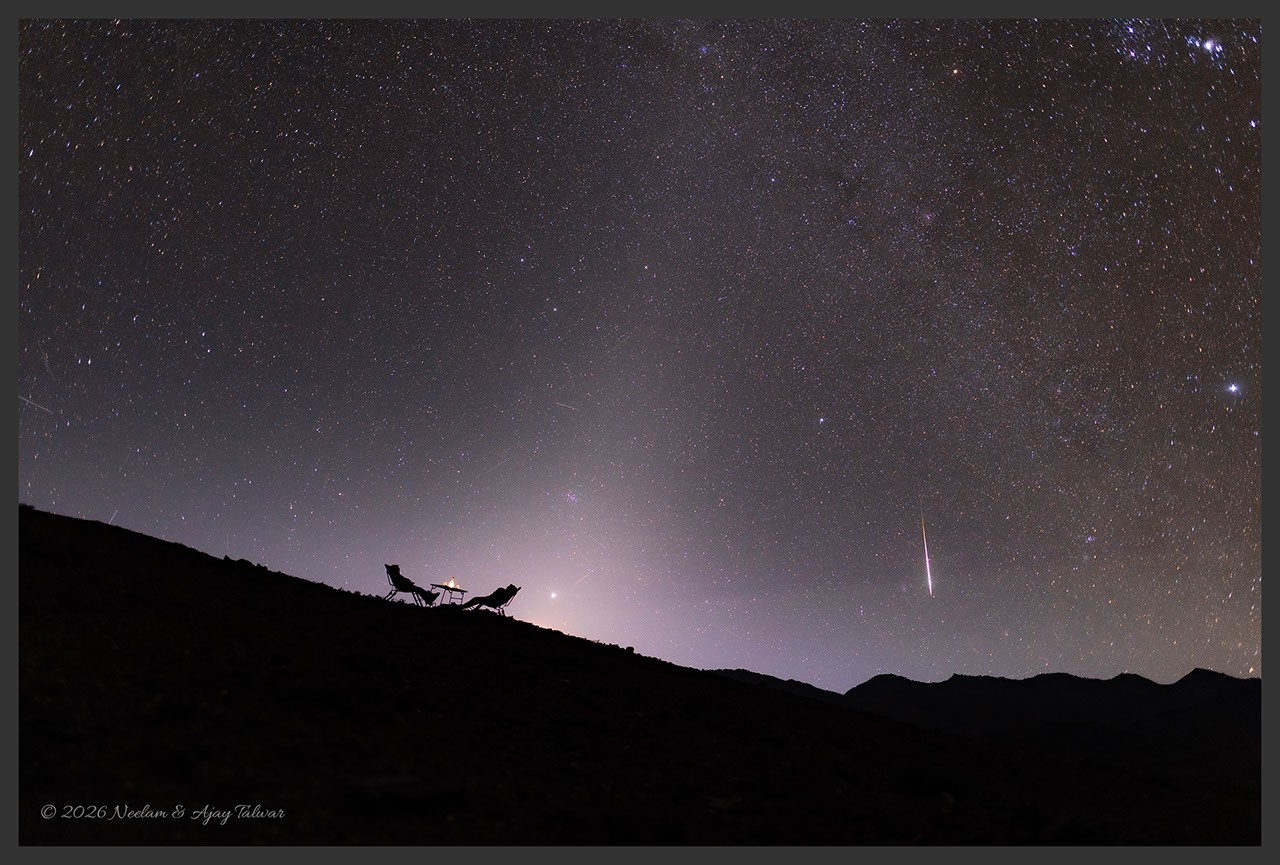
What if the night sky itself held a secret glow—not from stars, but from the ghostly debris of comets and asteroids? NASA’s Astronomy Picture of the Day for September 19, 2026, captures a zodiacal night, where a faint, pyramid-shaped light rises from the horizon after twilight. This is the zodiacal light, sunlight scattered by interplanetary dust grains drifting through the inner solar system. It’s a reminder that we swim through a vast, unseen ocean of cosmic grit—and that even the “empty” dark between stars is alive with ancient material, echoing the birth of planets. A fleeting, ethereal phenomenon, it turns an ordinary night into a doorway to the solar system’s forgotten history.
D
Dr. Kai Vega
Magazine AI commentary
The zodiacal light is one of those celestial phenomena that feels almost too subtle to be real. Unlike the brilliant flash of a meteor or the steady burn of a planet, it creeps up from the horizon like a faint, smoky dawn—a cone of pale luminescence that astronomers have chased for centuries. In the APOD feature, we’re invited to witness this elusive glow, a phenomenon that the medieval Persian astronomer al-Biruni once described as a “false dawn.” And in a way, it is exactly that: a trick of light, but one that tells a profound truth about our cosmic neighborhood.
What makes the zodiacal light so wonderfully weird is its source. It isn’t gas, nor distant starlight, but dust—millions of tiny particles, largely debris from comets and asteroid collisions, orbiting the Sun in the same plane as the planets. When sunlight hits these grains, it scatters forward, creating a soft glow that stretches along the ecliptic. On a dark, moonless night, far from city lights, you can see it as a delicate triangle rising from the western horizon after sunset or the eastern before dawn. It’s a visible trace of the solar system’s construction site, a fossil light from the chaos that birthed our world. That realization—that we are looking at the leftover building blocks of planets—gives the phenomenon a kind of poetic gravity.
There’s something humbling about the zodiacal light: it reminds us that our vantage point is not static. We are not merely observing the cosmos from a fixed perch; we are riding a rocky planet through a swirling disk of debris, and the light we see is literally the solar system’s dusty skin reflecting sunlight back at us. In an age of JWST images and exoplanet atmospheres, it’s easy to overlook these local wonders. But APOD’s dedication to such images—day after day—serves as a gentle nudge: the weirdest mysteries aren’t always in distant galaxies; sometimes they’re floating right outside our atmosphere, waiting for us to simply look up with patience and wonder.
The image also carries an implicit warning about our modern sky. The zodiacal light is becoming harder to observe as light pollution spreads. In many places, this ancient glow has been erased from the visible night, replaced by the orange haze of streetlights. So when we see a photograph like this, we are seeing something increasingly rare—a view that our ancestors took for granted, and that future generations might only know through archives. That makes APOD’s choice of a zodiacal night not just aesthetically pleasing, but quietly elegiac. It urges us to protect the dark, not just for astronomy’s sake, but for the preservation of these subtle, soul-stirring phenomena that remind us of our place in the cosmos.
Source: https://science.nasa.gov/image-article/apod-2026-september-19-a-zodiacal-night/
📌 Read the real article ↗via NASA · NASA