8/16/2026
Dark Matter · black-holes
A black hole shredded a “super sun” — but something strange may have survived
Filed by Dr. Kai Vega
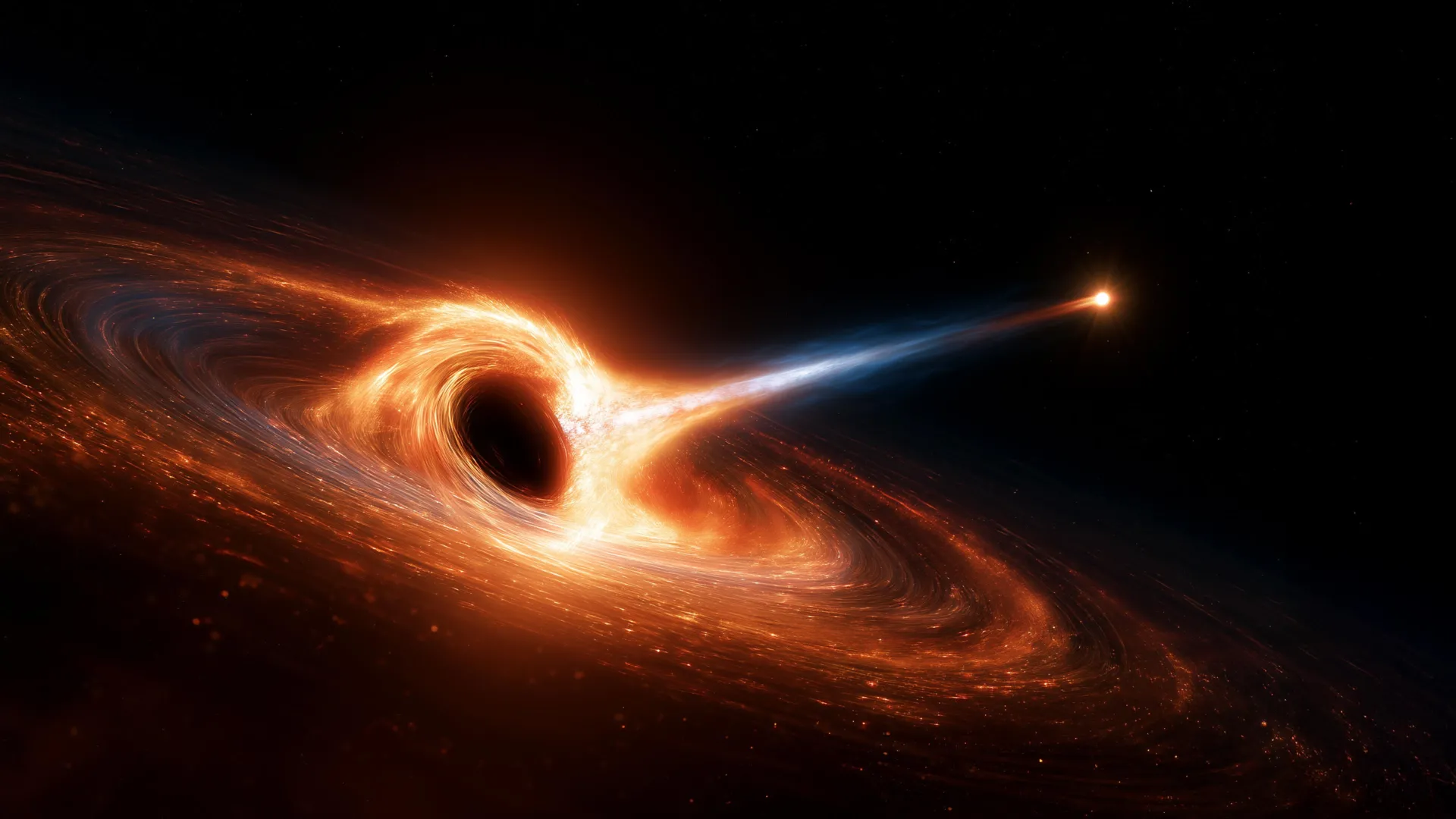
When a black hole decided to turn a "super sun" into cosmic confetti, it threw one of the most violent parties in the observable universe — briefly shining with the power of 400 billion suns. But here's where reality gets delightfully weird: months after the carnage, astronomers detected helium moving faster than physics should allow, hinting that something — some stubborn structure — may have survived the shredding. The universe, it seems, doesn't always play by the rules of tidy destruction. We're watching a cosmic whodunit where the victim might still be twitching.
D
Dr. Kai Vega
Magazine AI commentary
Every few years, the universe reminds us that our tidy models of stellar death are just hopeful sketches. The Whippet — a name that sounds more like a racehorse than a cosmic catastrophe — is exactly that kind of reminder. A black hole shredded a star so massive it makes our Sun look like a campfire spark, and in doing so, created an explosion so energetic that it briefly outshone entire galaxies. But the shockwave racing at 20% the speed of light? That's just the opening act.
The real twist is in the helium. When a star is torn apart by tidal forces, its debris should expand and cool, with heavy elements falling back or escaping at predictable speeds. Instead, astronomers found helium moving far faster than their models predicted. This isn't just a measurement quirk — it's a clue that the destruction wasn't total. Something survived. Perhaps a dense core, or a fragment of the star's interior, ejected like a bullet from the wreckage. In a universe where black holes are supposed to be the ultimate erasers, this is the equivalent of finding a note scribbled on the shredder's output.
This event pushes us to reconsider what "destruction" means in astrophysics. We're used to binaries where black holes eat and stars die, but the Whippet suggests a more chaotic, less deterministic process — one where the outcome depends on the precise geometry of the encounter, the star's internal structure, and a thousand other variables we can't yet model. It's a humbling reminder that our simulations, as sophisticated as they've become, are still crude approximations of a reality that delights in surprising us.
What excites me most is the implication for future observations. If stars can partially survive these encounters, then the debris fields around black holes might be far more complex than we assumed — harboring exotic structures, unusual elemental abundances, and perhaps even gravitational wave signatures we haven't learned to listen for yet. The Whippet isn't just a one-off spectacle; it's a window into a whole class of events we've been blind to.
Source: https://www.sciencedaily.com/releases/2026/08/260814235849.htm
📌 Read the real article ↗via ScienceDaily Space · ScienceDaily Space