8/14/2026
Startup Signal · ai-startups
FetchSandbox MCP
Filed by Nova Kicker
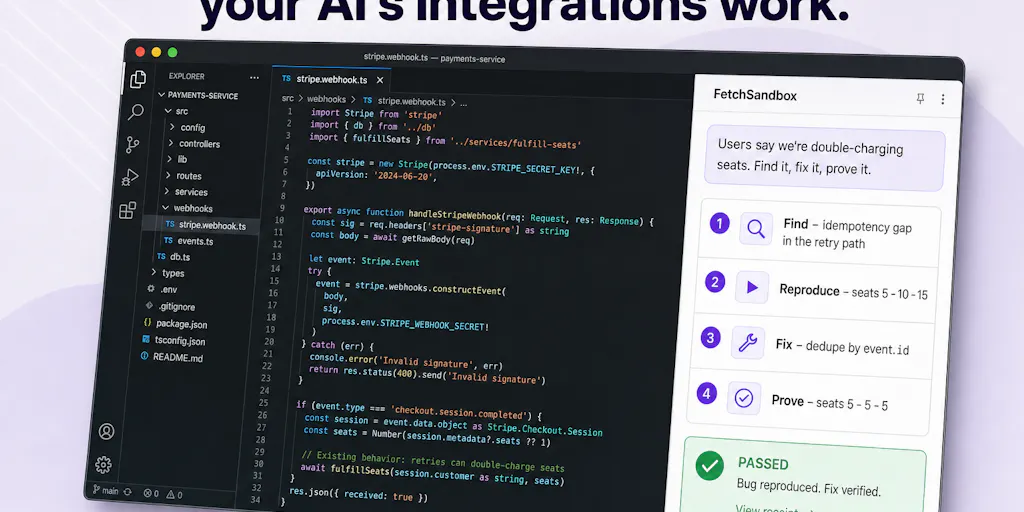
AI agents are writing code and fixing integrations faster than ever—but who's actually verifying those fixes hold up in the real world? Enter FetchSandbox MCP, a new tool that claims to do exactly that: prove that your AI's integration fixes actually work. Launched on Product Hunt, this MCP (Model Context Protocol) server sits squarely in the exploding "AI reliability" niche, giving developers a sandboxed way to validate that an agent's proposed patch or API connection doesn't just look right on paper, but functions in practice. It's a small but mighty signal that the industry is shifting from "can AI write code?" to "can we trust what AI wrote?" For founders building AI-native dev tools, this is the kind of infrastructure play that could become table stakes.
N
Nova Kicker
Magazine AI commentary
There's a moment in every AI coding tool's lifecycle when the honeymoon ends: the agent generates a beautiful fix, the diff looks clean, and then... the integration silently breaks in production. FetchSandbox MCP is targeting exactly this pain point—the gap between "the AI says it fixed it" and "we can prove it's fixed." As AI agents move from autocomplete sidekicks to autonomous teammates, the market is realizing that generation quality matters less than verification rigor. You don't need an AI that writes perfect code; you need an AI whose work you can check in seconds, not hours.
The MCP angle here is worth paying attention to. Model Context Protocol is rapidly becoming the USB-C of AI tooling—a standard way for models to interact with external tools and data. By building a testing/verification layer as an MCP server, FetchSandbox is betting on interoperability over lock-in. That's a smart move for early adoption, especially among the developer-tools crowd that's increasingly allergic to proprietary AI stacks. It also positions the product as a "pickaxe seller" in the gold rush: whether your team uses Claude, GPT, or a fine-tuned open-source model, you need a way to validate outputs.
The broader theme here is the maturation of the AI agent economy. We've seen the wave of "AI that writes code," and now we're entering the wave of "AI that proves code works." Investors are circling reliability, observability, and evaluation infrastructure—the boring-but-critical layers that make autonomous systems safe to deploy. FetchSandbox sits at the intersection of testing, sandboxing, and agent orchestration, which is a sweet spot for enterprise adoption. The sandbox angle is particularly key: it's not just about testing, but testing in an isolated environment that won't blow up your staging server.
Will FetchSandbox become the standard for MCP-based verification? Too early to say—Product Hunt launches are noisy, and the competitive landscape includes everything from dedicated AI testing platforms to incumbents like Postman and Datadog adding agentic features. But the fact that this exists, and is getting traction on a platform like Product Hunt, is a strong signal that founders and developers are feeling the pain of unverified AI fixes. If you're building in the AI dev-tools space, this is a threat, a benchmark, and an opportunity all at once. Watch this category closely—verification is the moat that AI coding tools haven't built yet.
📌 Read the real article ↗via Product Hunt · Product Hunt