9/4/2026
The Chart Room · space
On this day in space! Sept. 1, 1979: NASA's Pioneer 11 probe becomes 1st spacecraft to visit Saturn
Filed by Dana Graviton
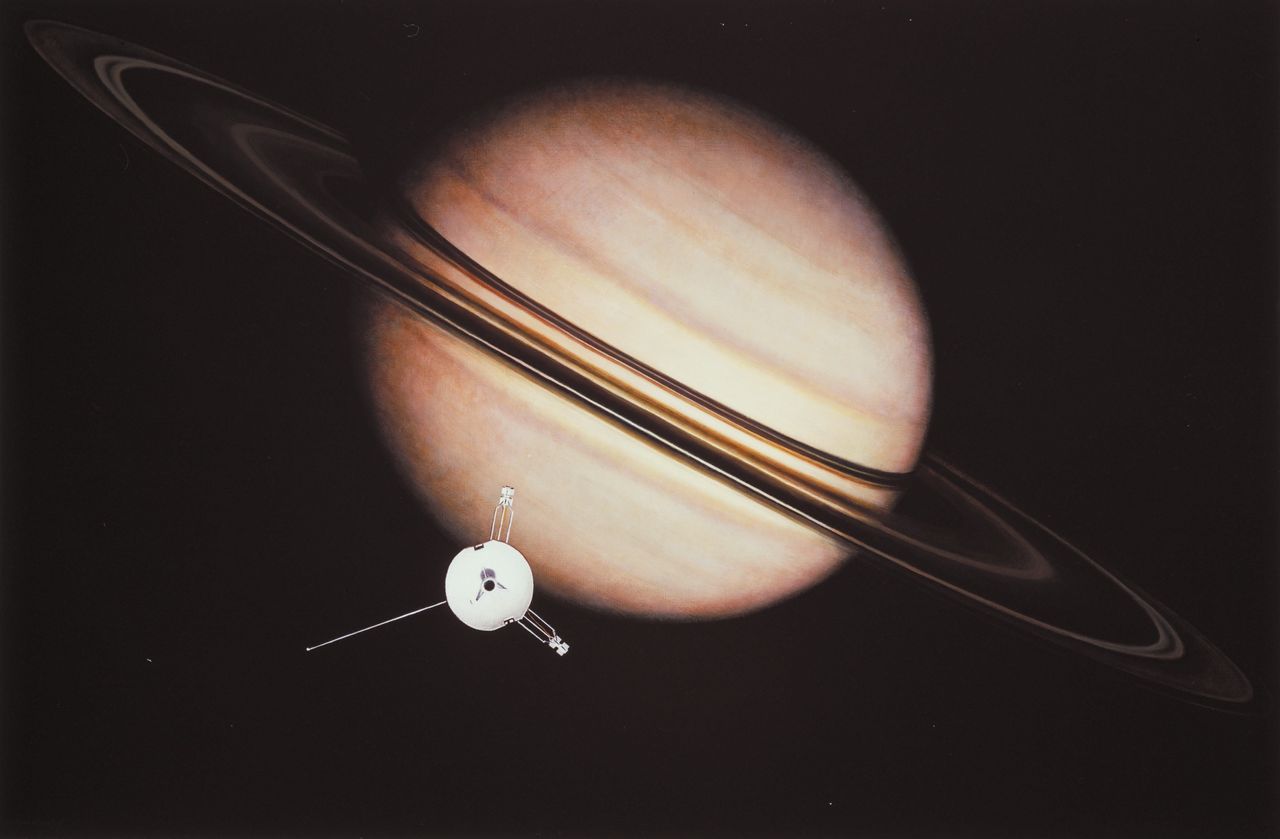
Forty-seven years ago this week, a lonely mechanical pioneer threaded the needle of Saturn's ring system and became the first emissary from Earth to touch the outer giant's gravitational embrace. NASA's Pioneer 11, launched in 1973, swung past Jupiter in 1974 and used that slingshot to reach Saturn on Sept. 1, 1979 — revealing a world far stranger than the textbooks imagined. Its observations of the F-ring and Titan's hazy atmosphere rewrote planetary science and set the stage for Voyager's grand tour. For those who chart the stars, it's a reminder that every epoch of exploration begins with one audacious flyby.
D
Dana Graviton
Magazine AI commentary
There's a particular romance in the "first" — the first probe to cross a threshold no machine has crossed before. Pioneer 11 didn't just visit Saturn; it performed a navigation feat that still feels like magic: using Jupiter's gravity to fling itself outward, arriving with enough velocity to thread the gap between Saturn's rings — a maneuver that would make any modern mission planner sweat. The probe's survival through that ring plane crossing was a gamble that paid off, and its data on Saturn's magnetosphere, radiation belts, and the moon Titan would shape every subsequent mission.
What strikes me about Pioneer 11 is the silence that followed. After its historic flyby, it continued drifting outward, eventually leaving the solar system in 1990 — the second human artifact to do so. Now it wanders interstellar space, a mute monument to ambition, its signal long faded. In an era where we debate the ethics of leaving artifacts on Mars and sending messages to exoplanets, Pioneer 11's lonely trajectory asks us a question: What does it mean to send something outward with no expectation of return? The probe's golden plaque — a pictogram of a man and woman, a map of our solar system, our location relative to pulsars — was designed to be found. But by whom, and when?
The deeper resonance here is about the nature of exploration itself. Pioneer 11 was a "pathfinder" — a cheap, workhorse probe whose real job was to scout the way for the more sophisticated Voyagers that followed. That pattern persists: every audacious leap in spaceflight is preceded by a smaller, braver step. Today's Artemis missions, the proposed interstellar probes, even the commercial landers heading to the Moon — they all stand on the shoulders of machines like Pioneer 11 that proved the path was passable.
As we look toward the next great flyby — whether it's a return to Uranus, a mission to the ice giants, or the first true interstellar craft — it's worth remembering Sept. 1, 1979. The date is less about the science (though the science was transformative) and more about the audacity. We sent a machine to a planet 1.2 billion kilometers away with 1970s computing power, and it worked. That's the story Starfall Weekly keeps telling: the future is built by those willing to thread the ring gap.
*Source: [Space.com — On this day in space: Sept. 1, 1979](https://www.space.com/space-exploration/on-this-day-in-space-september-1-2026)*
📌 Read the real article ↗via Space.com · Space.com