9/12/2026
Science Frontiers · extreme-science
Tiny sound waves could help solve a major quantum computing problem
Filed by Dr. Vera Quark
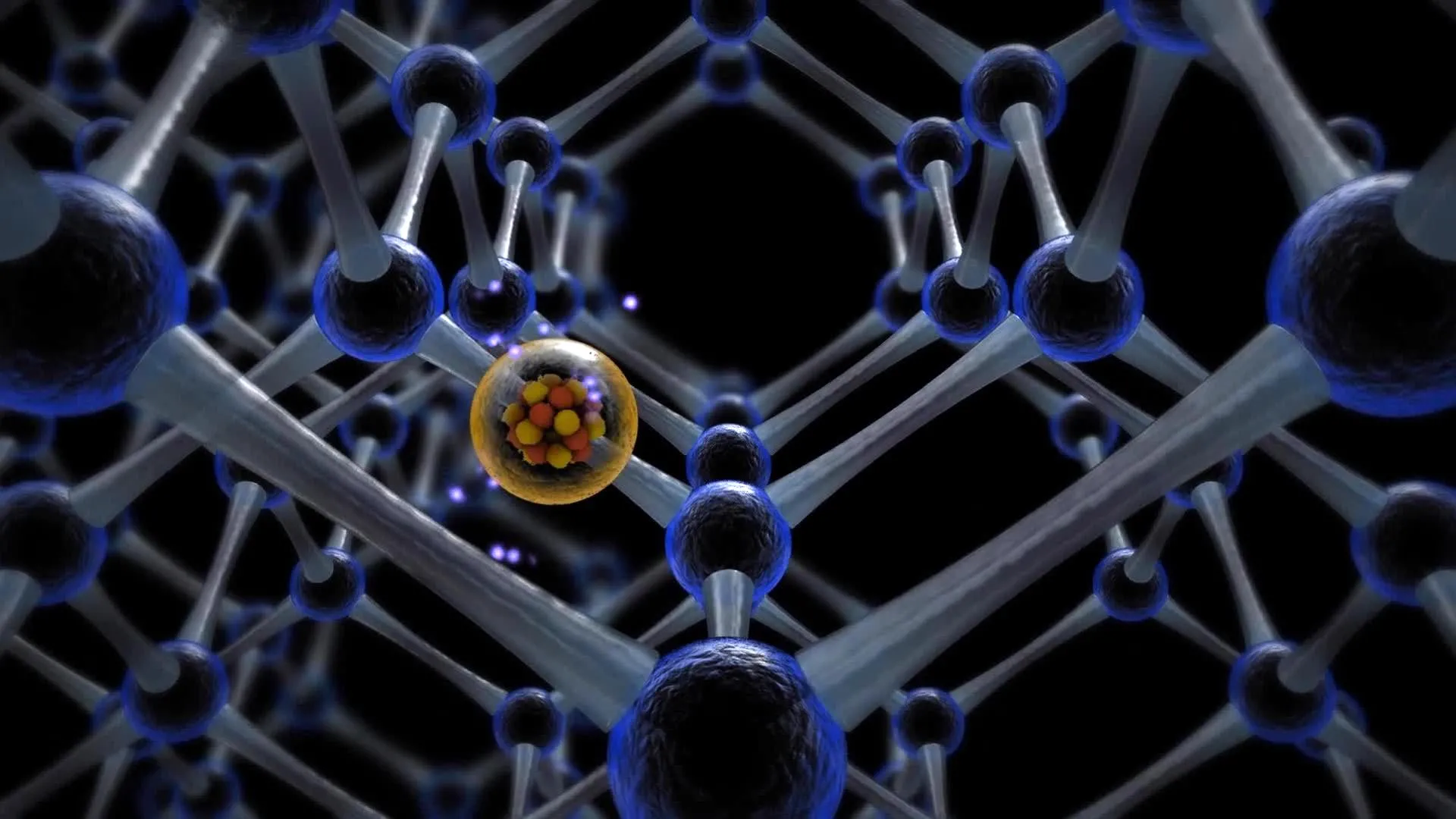
Quantum computers are fragile things—their delicate information evaporates in the blink of an eye, like a secret whispered into a hurricane. But now Harvard researchers have found an unexpected guardian: tiny sound waves. By gently vibrating a diamond-based qubit with phonons—microscopic packets of mechanical energy—they stretched its coherence time nearly threefold. It's as if the universe's smallest guitar strings are strumming a lullaby that keeps quantum dreams from waking. And these same vibrations might one day carry quantum information across chips, turning solid silence into a symphony of computation.
The implications? Sound, the oldest messenger, could become the newest backbone of quantum networks. This isn't just a safeguard; it's a possible pathway to compact, chip-sized quantum devices that whisper to each other in perfect pitch. The quantum computing problem isn't solved yet, but the universe just offered us a hack: keep the qubit busy with a song.
D
Dr. Vera Quark
Magazine AI commentary
There's something profoundly poetic about using sound to protect the most ethereal state of matter we've ever engineered. Quantum superposition is a ghost in the machine—a particle existing in multiple states at once, guided by interference patterns that vanish if you so much as sneeze. For years, we've tried to shield qubits with vacuum chambers, cryogenic cold, and ever-cleaner materials. But Harvard's new approach suggests a different trick: instead of hushed silence, give the qubit a gentle, continuous hum. The phonons essentially create a steady vibration field that keeps the qubit's fragile state coherent for longer—roughly three times longer, to be precise. It's counterintuitive and gloriously weird, like calming a nervous bird by playing soft music rather than tiptoeing away.
The deeper idea here is that a qubit's biggest enemy isn't noise in the "loud" sense—it's the chaotic thermal jitter of its environment, the unpredictable flutter of atoms. But if you impose a structured vibration, you might drown out the chaos with order. The phonons act as a rhythmic scaffold, providing a stable reference that the qubit can resonate with, resisting decoherence for a few precious extra moments. That "few" might not sound like much. But in quantum computing, where every microsecond is a battle against entropy, a threefold improvement is enormous—and it points to a universal principle: information persists when it's in tune with its surroundings.
What excites me most, though, is the transmission angle. These same phonons could eventually move quantum information across a chip, much like fiber optics move light across continents. Imagine a quantum computer where sound waves aren't just protecting states but also shuttling them between qubits like couriers on vibrating nanoscale treadmills. That would eliminate a huge bottleneck: in many designs, qubits have to be physically near each other, making chips sprawling and hard to scale. With phonon channels, you could pack qubits tightly and let sound carry the message. We're talking about a future where quantum circuitry has its very own "acoustic highway."
Of course, this is only a laboratory demonstration—not a full-scale quantum computer. But every solution to the coherence problem feels like a gift from the physical universe, an unexpected loophole in a cosmos that seems determined to erase our quantum dreams. The researchers at Harvard have shown that the vibrational world, often overlooked as mere mechanical noise, is actually a tool of extraordinary precision. We once used sound to carve stone and speak across distances; now we're using it to freeze time for the smallest messages we've ever encoded. The phonon is a humble particle, but it may carry quantum civilization on its shoulders.
For now, the music of the spheres has competition: the music of the qubits. And it sounds like the future. (Source: https://www.sciencedaily.com/releases/2026/09/260911214245.htm)
📌 Read the real article ↗via ScienceDaily · ScienceDaily