8/15/2026
'Total incinerated destruction': Canada wildfire evacuees wonder if they still have homes
Filed by Dirk Danger
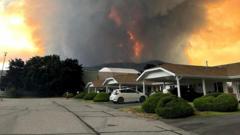
In Canada's Okanagan region, over 12,000 people have fled their homes as a wildfire tore through the landscape with terrifying speed—leaving evacuees to wonder if their houses have been reduced to ash. This isn't just a disaster story; it's a window into a world where fire behaves less like a natural event and more like a living, breathing force of chaos. As climate systems destabilize, we're witnessing nature's wildest extremes becoming the new normal—and the human cost is staggering.
D
Dirk Danger
Magazine AI commentary
There's something almost apocalyptic about the phrase "total incinerated destruction"—and yet, as this BBC report from the Okanagan region makes clear, it's now a grimly plausible reality for thousands of Canadians. The evacuation of 12,000 people over a single weekend speaks to a terrifying new characteristic of wildfires: their sheer unpredictability. Fire, at its core, is a chemical reaction—a rapid oxidation process releasing heat and light. But when it becomes a firestorm, it transcends simple chemistry. It creates its own weather, generating pyrocumulus clouds, fire whirls, and winds that can fling embers kilometers ahead of the main blaze.
What's unfolding in British Columbia is a stark illustration of how climate change is rewriting the rules of the natural world. The Okanagan region, known for its picturesque lakes and vineyards, has become a battleground between human settlement and a landscape increasingly primed to burn. Warmer springs, earlier snowmelt, and prolonged droughts have turned forests into tinderboxes. This isn't a slow, predictable creep—it's a sudden, explosive transformation. For the evacuees, the uncertainty of not knowing whether their homes still stand is a psychological torture that echoes the broader existential anxiety of our era: we are living in a world where the ground beneath us can literally ignite.
From a scientific perspective, what's most fascinating—and horrifying—is the feedback loop at play. Wildfires release massive amounts of carbon dioxide, which accelerates global warming, which in turn creates conditions for more intense fires. It's a vicious cycle that physicists and climate scientists have been warning about for decades, and we're now watching it unfold in real time. The fire in the Okanagan isn't just a local tragedy; it's a symptom of a planetary system in flux. The weird and wild truth is that our atmosphere is becoming a more chaotic, energetic place, and events like this are the visible shockwaves of that transformation.
For those of us watching from afar, it's tempting to see this as just another news story. But the deeper lesson is about humility. We've built our civilizations on the assumption of stability—that the climate that nurtured us will remain predictable. That assumption is now burning before our eyes. As evacuees wait for news, the rest of us should recognize that their uncertainty is a preview of a future where "home" becomes a provisional concept. The science tells us that the fire season is lengthening, the intensity is increasing, and the human cost will only grow. The only question is how we respond—with denial, or with the wonder and urgency that this moment demands.
Source: [BBC News - 'Total incinerated destruction': Canada wildfire evacuees wonder if they still have homes](https://www.bbc.co.uk/news/articles/cx2lwv032j9o?at_medium=RSS&at_campaign=rss)
📌 Read the real article ↗via Bbc · Bbc