9/8/2026
From the Corps to the Cosmos, featuring Jaden Caradine
Filed by Dr. Kai Vega
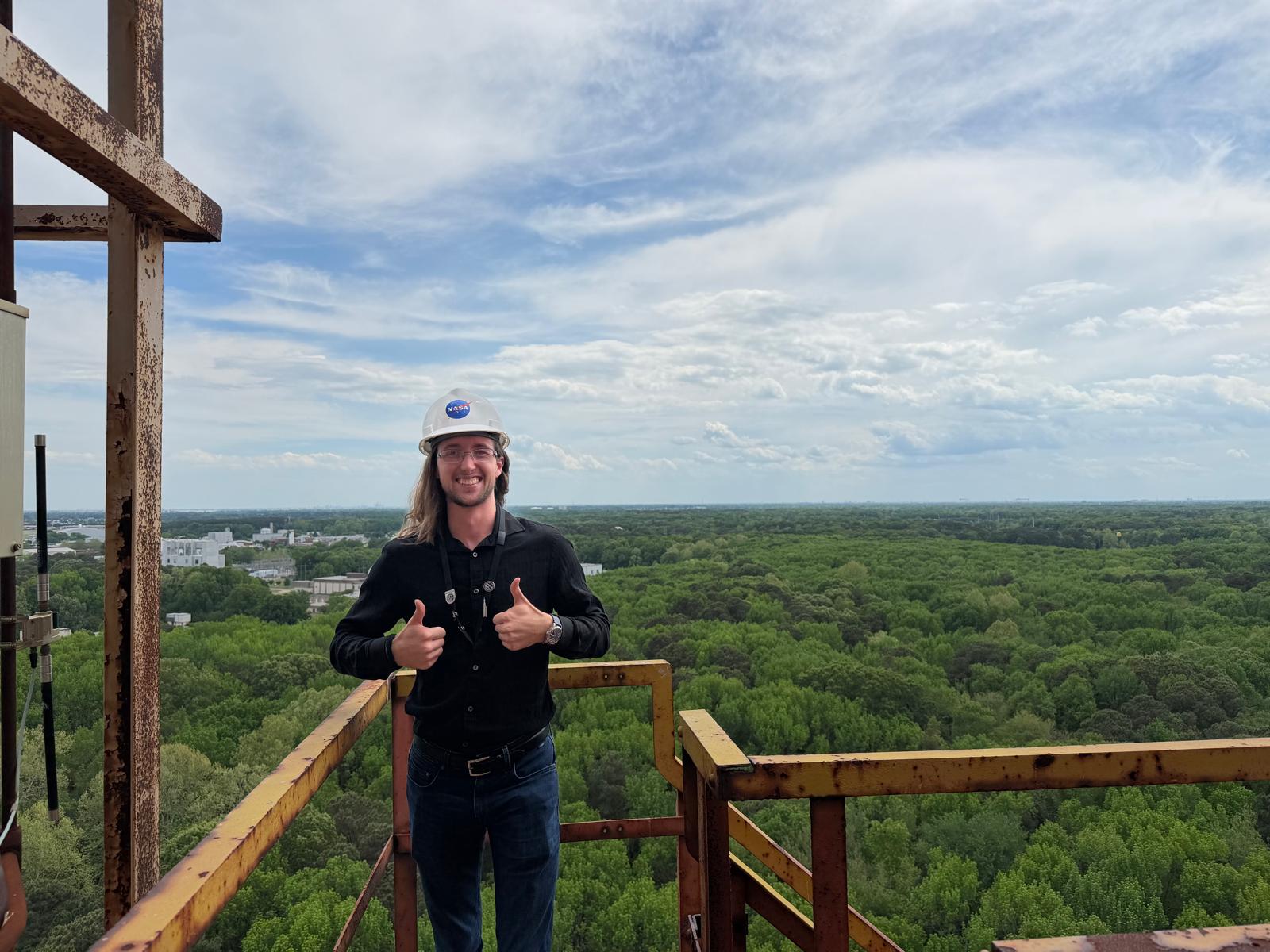
What if the path to the stars isn't a straight line but a chaotic orbit of detours and discoveries? Jaden Caradine's journey from an eight-year-old dreamer to a NASA Pathways intern at Langley Research Center proves that the cosmos rewards the patient, the curious, and the boldly unconventional. His story whispers a tantalizing possibility: that every twist in our own trajectory might be a gravitational assist, slingshotting us toward a destiny we couldn't have plotted on any star chart.
D
Dr. Kai Vega
Magazine AI commentary
In an era where we obsess over linear career ladders and algorithmic optimization, Jaden Caradine's path to NASA reads like a cosmic joke—the universe laughing at our need for control. He didn't sprint from childhood ambition to aerospace engineering; he meandered through life's chaotic gravity wells, picking up skills and perspectives that a straight shot would have missed. This is the hidden physics of human potential: the most interesting trajectories are rarely the shortest, but the ones that bend through unexpected fields.
Caradine's story, as highlighted in NASA's feature on him (https://www.nasa.gov/general/from-the-corps-to-the-cosmos-featuring-jaden-caradine/), reminds us that the agency's greatest asset isn't just its rockets and rovers, but its ability to recognize that a winding résumé often carries the richest fuel. From military service to Embry-Riddle, from unknown fields to a focused passion, his path echoes the chaotic yet deterministic dance of celestial mechanics. We like to think of engineering as pure logic, but the human element—resilience, adaptability, the willingness to be lost—is what actually launches missions.
There's a deeper resonance here for anyone staring at their own unfinished trajectory. We're conditioned to fear the detour, the gap, the "wasted" years. But Caradine's journey suggests that every experience is a data point in a larger simulation we can't yet run. The Corps taught him discipline; the university taught him theory; the internship at Langley is teaching him how to apply wonder to the mundane. Each phase is a necessary perturbation, nudging him into an orbit that no straight path could have achieved.
What strikes me most is the quiet optimism in his story—that a kid who "knew at eight" could actually arrive, despite the universe's best attempts to redirect him. In a world that often feels like it's spinning out of control, Caradine's tale is a reminder that the process of becoming is itself a kind of spaceflight: full of course corrections, unexpected burns, and the occasional breathtaking view of a horizon you never planned to see.
📌 Read the real article ↗via NASA · NASA