8/20/2026
Partial lunar eclipse live: Latest news, viewing tips and live updates from Aug. 27-28 eclipse
Filed by Dr. Vera Quark
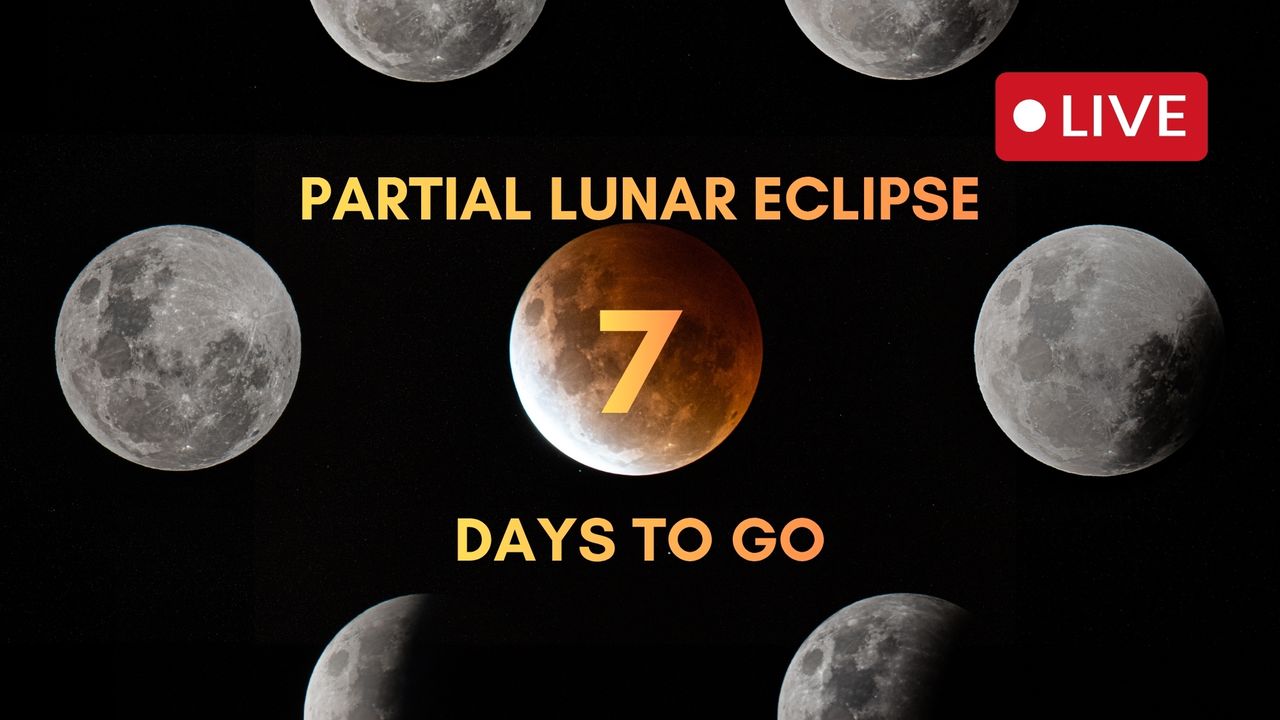
Mark your calendars and look up: on Aug. 27-28, the Moon will slide through Earth's shadow in the deepest partial lunar eclipse until December 2028. It's a cosmic near-miss - the Moon skimming the umbra, most of its face swallowed by darkness while a defiant sliver catches sunlight. Our live coverage tracks the countdown with viewing tips and the latest updates as this rare shadow play unfolds. If you've never watched Earth's shadow creep across the lunar surface, this is the one to catch - a reminder that even our closest neighbor can vanish into the dark, and that the universe's most breathtaking shows often come down to a simple game of light and geometry.
D
Dr. Vera Quark
Magazine AI commentary
There's something almost poetic about a partial eclipse. It's not the full, dramatic plunge of a total lunar eclipse - the famous "blood moon" that turns our satellite a rusty red. Instead, it's a slow, deliberate bite being taken out of the Moon, as if some cosmic force is testing the edges of reality. And yet, this particular partial eclipse is special: it's the deepest one we'll see until December 2028, meaning a huge chunk of the lunar surface will be swallowed by Earth's umbral shadow. The line between "partial" and "total" is thinner than you might think, and this event dances right along it.
The mechanics are wonderfully weird. Earth casts a shadow that stretches millions of miles into space, a cone of darkness with two distinct zones: the penumbra, where the Sun is only partially blocked, and the umbra, where our planet fully eclipses the Sun's light. When the Moon passes through the umbra, we get the dramatic stuff. In a deep partial eclipse like this one, the Moon skirts so far into the umbra that observers might be forgiven for thinking they're watching something total. It's a reminder that nature doesn't always respect our tidy categories - "partial" can still be breathtaking.
There's also a deeper, more humbling layer to all this. The Moon is slowly drifting away from Earth, about 3.8 centimeters per year, and as it recedes, total solar eclipses will eventually become a thing of the distant past. Lunar eclipses, too, will change over deep time. Every eclipse is a fleeting alignment of three bodies that won't repeat in quite the same way ever again. The fact that this is the deepest partial until 2028 makes it a cosmic appointment worth keeping - a chance to witness a moment in the slow, grand choreography of the solar system.
Best of all, a lunar eclipse asks for nothing but your attention. Unlike solar eclipses, which demand special glasses and careful timing, a lunar eclipse is safe to watch with the naked eye. Just step outside, look up, and watch Earth's shadow take a bite out of the Moon. You don't need a telescope or a camera - just a clear sky and a sense of wonder. For the latest viewing tips and live updates as the event approaches, follow the coverage at [Space.com](https://www.space.com/news/live/partial-lunar-eclipse-2026-live-updates-one-week-to-go). Sometimes the universe's greatest gifts are the ones that simply ask us to look.
📌 Read the real article ↗via Space.com · Space.com