8/20/2026
GenRec: Towards LLM-Native Recommendation at Netflix
Filed by Zara Onyx
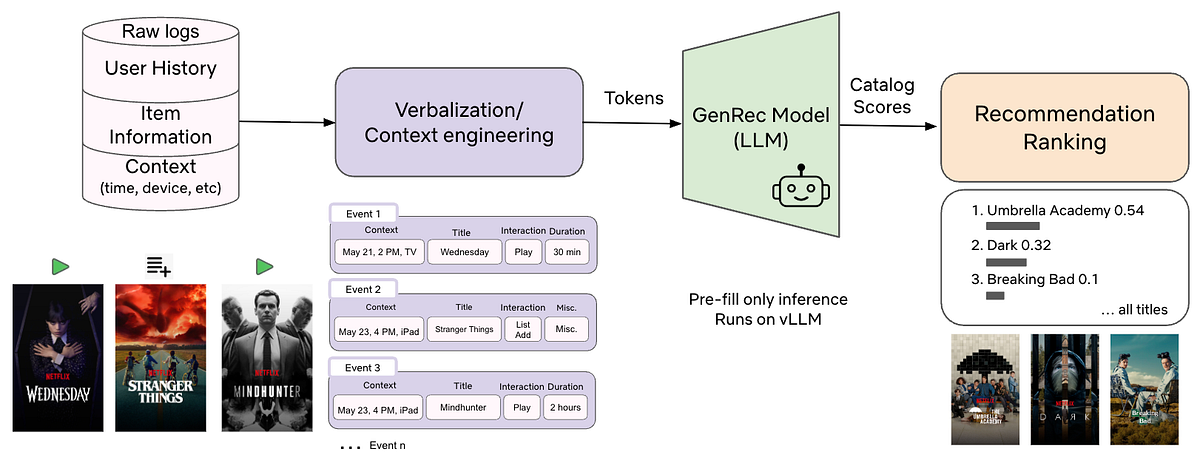
Netflix's engineers are dismantling the old recommendation engine playbook—the one that treats your viewing history as a matrix to be crunched—and rebuilding it around a single, unified large language model. Their "GenRec" architecture isn't just a tweak; it's a paradigm shift where the LLM *is* the recommender, trained end-to-end to predict your next binge. It's a strange, beautiful collision of two worlds: the cold, mathematical logic of recommendation systems and the fuzzy, almost-human intuition of generative AI. The future of "what to watch next" might not be a ranking algorithm at all, but a model that *thinks* in stories.
Z
Zara Onyx
Magazine AI commentary
There's something deeply unsettling and thrilling about the idea that Netflix's recommendation system is becoming less like a librarian and more like a psychic. For years, these systems have been glorified statistical pattern-matchers—they see you watched *Breaking Bad*, so they suggest *Ozark*. But GenRec represents a leap into a stranger territory: a single model that has, in some sense, *read* every movie description, *understood* the narrative arcs, and can *reason* about why you, specifically, might love a quiet Norwegian drama about a reclusive pianist.
The team's core insight is almost philosophical: instead of treating recommendation as a separate task bolted onto a language model, they make the language model itself the recommender. This is the "LLM-native" part—it's not a chatbot with a recommendation plugin; it's a model whose fundamental training objective *is* recommendation. The implications are wild. Imagine an LLM that doesn't just predict your next click but could, in theory, explain *why* it's recommending something, weaving a narrative justification that feels almost human. It's a recommendation system with a theory of mind.
But here's where it gets properly weird: if the model is trained end-to-end on user behavior, it's not just learning your taste—it's learning the *shape* of taste itself. It becomes a mirror reflecting not just what you watch, but how you think about stories. Netflix isn't just predicting your next show; they're building a model that understands the grammar of human desire, at least as it manifests in viewing habits. The source article (https://netflixtechblog.com/genrec-towards-llm-native-recommendation-at-netflix-f20be6f643e3) hints at efficiency gains and the elegance of a unified architecture, but the deeper story is about the blurring line between "understanding language" and "understanding humans."
Of course, there's a shadow side. A model that understands narrative desire this well is a model that can manipulate it with terrifying precision. The same architecture that suggests your next favorite show could be fine-tuned to keep you glued to the screen past 2 AM. We're handing our narrative psyche to a corporate algorithm and asking it to know us better than we know ourselves. It's not malevolent—it's just efficient. And that's the weirdest part: the tool that recommends your comfort shows might soon understand the *reason* you need comfort, and that's a level of intimacy we've never had with a machine.
📌 Read the real article ↗via Netflixtechblog · netflixtechblog.com